Steam boiler design reconciles a linked set of specification conditions: steam duty, pressure, fuel, load profile, emissions limit, efficiency guarantee basis, and construction code. A specification holds only when those entries agree with one another. Most problems found late are incompatible entries rather than wrong ones. A capacity quoted in a different unit from the one it was calculated in, or an efficiency figure with no stated basis, will pass a casual read and fail at fabrication. Each entry fixes something downstream, and the whole set can be tested for consistency before a drawing is released. U.S. ASME and EPA requirements serve as the code examples here; projects elsewhere apply their own boiler and emissions framework.
What a Steam Boiler Design Has to Reconcile

A steam boiler design carries two kinds of numbers, conditions the purchaser sets and figures the manufacturer derives from them, and only the first kind is comparable across quotations, because derived figures depend on each maker's boiler type and furnace geometry.
Purchaser-side conditions are steam duty, the pressure and steam condition the process needs, fuel, load profile and turndown, the site emissions limit, the efficiency guarantee basis, and the construction code. Furnace volume, heating surface, tube geometry, burner selection, economizer surface, fan duty, and pressure-part thickness all follow from those. Comparing two quotations on heating surface alone tells you little. Two makers can reach the same duty with different geometry.
The table below sets out one illustrative package of purchaser conditions, with the entries that have to move when any single line changes.
Specification line | Example entry | What has to move if this entry changes |
Base and peak steam duty | 17,000 / 19,000 lb/hr | Furnace volume, firing rate, feedwater and condensate equipment |
Pressure required at the highest-demand user | 100 psig | Boiler outlet pressure, distribution and header sizing |
Boiler design pressure and MAWP | Stated separately, above outlet operating pressure | Pressure-part thickness, relief valve sizing, applicable code section |
Feedwater temperature at the boiler | 180°F | Steam output in lb/hr at a given heat input, economizer and deaerator duty |
Steam condition | Saturated | Whether a superheater is in scope, and the code parts covering it |
Fuel, and backup fuel if any | Natural gas | Furnace geometry, burner, fuel handling, emissions route |
Required turndown | 5:1 | Burner and control selection, one unit or several |
Efficiency guarantee basis | Fuel-to-steam, HHV, at a stated load and feedwater temperature | Recovery surface in scope, stack temperature target, test method |
Emissions limit applying at the site | Project and jurisdiction specific | Burner type, flue-gas treatment, permitting timeline |
Construction code | ASME BPVC Section I | Material, welding, inspection, stamping, documentation |
Steam duty and design pressure close first, and the reason is sequence. Steam duty closes early because the derived figures are calculated from it. Design pressure closes early because it selects the pressure parts and the construction code, and neither reopens economically once material is cut. Fuel, turndown, and recovery surface can stay open longer, though each still has to close before fabrication.
Not every steam requirement justifies a purpose-designed package. For a small, intermittent, low-pressure duty, a catalogue packaged unit, or a steam generator in place of a boiler, will cost less and take far less engineering than anything specified from scratch. The work described here earns its keep when the duty is large, the pressure sits above the code boundary, or the fuel is something other than pipeline gas.
Where a Boiler Horsepower Rating and Delivered Steam Diverge
A boiler horsepower rating and the steam a plant receives at its own conditions are different quantities, and the size of the difference depends on the feedwater temperature and the pressure the rating was referenced to. Boiler horsepower is an equivalent evaporation rating referenced to water evaporated from and at 212°F, or about 33,475 Btu/hr per BHP.
Take a 600 BHP figure. At 34.5 lb/hr per boiler horsepower, that is 600 × 34.5 = 20,700 lb/hr of equivalent evaporation. A plant feeding 60°F makeup and raising steam at 100 psig asks for more heat per pound. Standard steam-table values put saturated steam at 100 psig near 1,190 Btu/lb and 60°F water near 28 Btu/lb, so about 1,162 Btu/lb has to be added, against the 970 Btu/lb the reference rating assumes. The ratio, about 1.20, is the factor of evaporation. Dividing by it gives approximately 17,300 lb/hr at those site conditions.
Read that figure for what it is. It is the site-condition evaporation rate implied by the same equivalent heat output, and it approximates: saturated steam, blowdown ignored, results that shift with the actual feedwater temperature. It is not a ceiling on every 600 BHP boiler in the market. Manufacturers may state rated BHP, maximum designed steaming capacity, fuel input, efficiency, reference feedwater temperature, and steam condition as separate lines. A real comparison runs across that full set of guarantee conditions.
Put your own figures into the same expression: divide the equivalent evaporation rating by (h_steam − h_feedwater) ÷ 970 to get output at your pressure and feedwater temperature.
The failure mode is predictable. A capacity figure carried across from an old nameplate, without checking the feedwater temperature and pressure it assumed, produces a boiler that meets its rating on paper and runs short at cleandown. The plant then buys a second unit or de-rates the process. Before we quote a package, we reconcile the capacity unit on the enquiry against the feedwater temperature and steam condition it was calculated at, because those numbers usually arrive from different documents.
Operating Pressure, Design Pressure, and the Construction Code
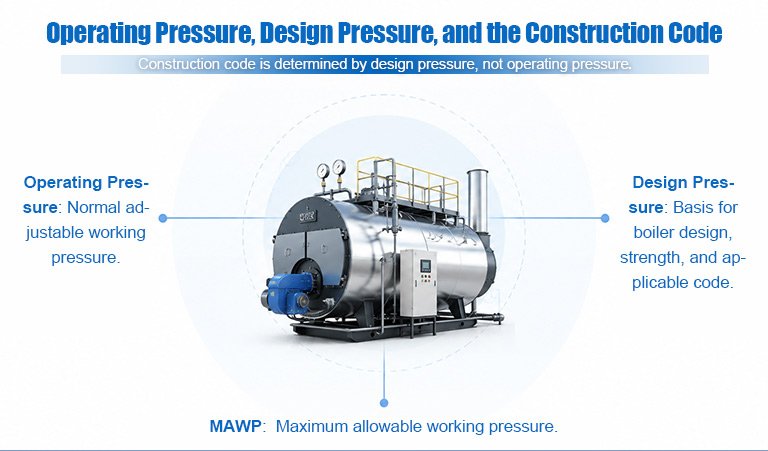
The construction code a steam boiler is built to follows from the pressure the unit is designed to generate steam at, not from where an operator later sets the pressure controller. For U.S. projects, boilers designed to generate steam above 15 psig fall within the power-boiler scope of ASME BPVC Section I (2025 edition), which also covers high-temperature water boilers above 160 psig or 250°F. Steam heating boilers intended for low-pressure service at or below 15 psig are generally constructed under Section IV, subject to the applicable jurisdiction and equipment classification. Both sections govern construction and stamping, which is separate from the operating permits and periodic inspections a jurisdiction imposes afterwards.
Four pressure figures therefore belong on the datasheet as separate entries: normal operating pressure, design pressure, MAWP, and safety-valve set pressure. A boiler built for higher allowable pressure does not become a heating boiler because a controller is turned down to 14 psig. A specification carrying one pressure number leaves the reader guessing which of the four it is.
The Section I boundary reaches further than many specifications assume. Pressure-containing economizer and superheater surfaces connected directly to the boiler without an intervening valve sit inside it, so they belong to the coded package from the start. An air preheater, sitting on the gas side, falls outside that category. Required pressure-relief capacity, meanwhile, is tied to the boiler's maximum designed steaming capacity under the applicable Section I overpressure-protection rules, so a capacity uprate late in a project pulls valve sizing and nozzle work along with it.
The set point and hardware distinction follows from that. A pressure controller setting is adjustable. Shell thickness, nozzle sizes, relief capacity, and the code section stamped on the nameplate are hardware decisions. Describing them to a client as adjustable later is how a plant buys the stricter code class by accident. Test the 15 psig line against the process user that requires the highest pressure, and add distribution losses to that figure before rounding anything. That rounding is expensive.
Emissions run on a separate track and are cheapest to resolve before the furnace and burner are fixed. At U.S. area sources, coal-, biomass-, and many liquid-fuel industrial boilers may be subject to EPA's area source boiler NESHAP (40 CFR Part 63, Subpart JJJJJJ), subject to that rule's own definitions and exclusions. Major sources sit under a separate subpart. State or local air districts frequently set the tighter NOx limit that ends up governing, so confirm the permitting route with the local air authority for the fuel and capacity actually chosen.
Fuel and the Component Sizes That Follow
Every major component in a steam boiler package is sized from a condition decided earlier, so a component list reads best backwards, from fuel and duty toward the equipment names. Natural gas and oil firing allow a compact furnace and relatively simple combustion equipment. Biomass and coal need larger furnace volume, fuel handling, ash removal, and a deliberate answer to fouling on the heat-transfer surfaces. The same steam duty therefore produces a physically larger unit on wood than on gas.
Recovery surface is a scope decision. A superheater earns its place when the process needs steam above saturation temperature, and an economizer earns its place when stack heat is worth recovering at the plant's real run hours. These measures combine rather than compete: an economizer, an air preheater, and tighter combustion control can be applied together, and which combination pays depends on fuel price, operating hours, and the stack temperature the fuel permits.
Feedwater chemistry sits outside this article but still constrains it. Tolerance for dissolved solids moves with pressure and boiler type, so settle a water-treatment plan before fixing tube material and blowdown provisions.
The Efficiency Guarantee Basis Behind a Quoted Percentage

An efficiency percentage on a boiler quotation becomes comparable only when the guarantee conditions behind it are stated, because the same unit yields different numbers depending on heating-value basis, load point, and where the measurement boundary is drawn. Combustion efficiency, thermal efficiency, and fuel-to-steam efficiency describe three different boundaries around one piece of equipment. An HHV figure and an LHV figure for the same combustion are not interchangeable.
Condition to state | Why the number moves without it |
Efficiency type | Combustion, thermal, and fuel-to-steam draw different boundaries |
Heating-value basis | The same energy flow divided by HHV or LHV gives different percentages |
Guaranteed load point | A high-fire figure says little about a unit running mostly at part load |
Feedwater temperature and steam condition | Both set the heat added per pound of steam |
Blowdown treatment | Determines whether blowdown energy counts as loss or output |
Economizer and recovery surface | Inside or outside the boundary changes measured output |
Auxiliary power | Fan and pump consumption counted or ignored |
Test method and correction basis | Fixes how test results are corrected to guarantee conditions |
ASME PTC 4-2013 (R2023), the performance test code for fired steam generators, defines the energy-balance and input-output methods and the correction of test conditions to guarantee conditions. Heat-recovery steam generators with supplemental firing are tested under PTC 4.4 instead, so naming the test method also fixes which code applies. Excess air and stack gas temperature remain the two levers with most influence on what a design can achieve. The U.S. Department of Energy's steam system sourcebook gives working rules of thumb for both, written at whole-system level, so a single datasheet sits inside a wider scope.
The fuel sets a practical floor under stack temperature. Flue gas from sulfur-bearing fuel condenses as acid below its dew point, and that dew point rises with sulfur content. A heavy-oil or high-sulfur solid-fuel plant therefore carries a higher minimum safe stack temperature, which leaves less recoverable heat for any economizer. Set the recovery target from that limit first, then size surface to it.
On plants where the load swings with batch startups, the burner and its controls are usually the first part of the package to show the cost of a boiler oversized for safety. Of everything on the datasheet, the efficiency clause is the line most worth arguing over, because it is the one a supplier can meet on paper and miss in service.
Specification Terms That Are Routinely Interchanged

Several terms on a boiler datasheet carry more than one meaning, and which one applies depends on whether the figure describes the equipment, the process, or the code.
Term as written | What it can mean | Action that makes it specific |
"600 BHP" / "20,700 lb/hr" | An equivalent evaporation rating, or output at site feedwater conditions | State the reference feedwater temperature and pressure behind the rating |
"92% efficient" | Combustion, thermal, or fuel-to-steam efficiency, on HHV or LHV | Ask for type, heating-value basis, load point, and boundary in writing |
"Design pressure" / "operating pressure" / "MAWP" | The construction figure, the running figure, or the maximum allowable | Give each as a separate line, and state which one sets the relief valve |
"High-pressure boiler" | A marketing description, or steam above the 15 psig code line | Give the psig figure and the code section the unit is stamped to |
"Steam generator" | A once-through or coil unit, or a small packaged boiler | Confirm which code the unit is built and certified to |
Before a Steam Boiler Design Is Released for Fabrication
A steam boiler design survives fabrication when its entries stay consistent with one another, and the two that most often break that consistency are the steam duty and the design pressure. Steam duty carries the rest because the derived figures are calculated from it. Design pressure carries the rest because it selects the pressure parts and the code section, and neither reopens cheaply once material is cut. A datasheet is best checked as a set.
At EPCB, we verify the design pressure against the process user that requires it before a package is released, and the duty figure against the feedwater conditions it was calculated at. Both checks cost a conversation now and a boiler later.
If your capacity is stated in boiler horsepower and your feedwater sits well below 212°F, run the factor of evaporation before comparing quotations, because two units with the same nameplate can deliver different steam at your conditions. If your process pressure sits within a few psig of 15, settle that number against the highest genuine user before the datasheet is issued. It decides the code section, the inspection regime, and a large part of the cost base.
FAQ
Should the specification call for a fire-tube or a water-tube boiler?
Usually neither. Pressure and duty narrow the field before preference enters, since fire-tube construction has practical ceilings on both, and naming geometry up front can exclude a compliant design. State the conditions and let the geometry follow. Where the ranges overlap, steam quality, load response, and floor space decide.
How much margin should a duty figure carry above calculated demand?
Set margin from the load profile instead of a fixed percentage. A steady continuous draw needs less than a plant where batch equipment starts together. Size it against a logged production cycle, and account separately for distribution and blowdown losses, which move with pipe run, insulation, and blowdown rate.
Does site altitude affect the design?
Yes. Air density falls with elevation, so burner and fan sizing has to be corrected for the site. Confirm the correction with the manufacturer at design stage.
Does an electric steam boiler need the same specification work?
Duty, pressure, and code class still apply, and pressure still selects the code section. What changes is the binding constraint: instead of furnace volume and flue routing, the limit becomes available electrical service capacity and the demand charges that follow from it.
Who is responsible for the code stamp?
Responsibility is shared. The purchaser or consulting engineer states the required operating conditions and the applicable construction code in the specification, while the ASME-authorized manufacturer builds and certifies the boiler to that code, with the authorized inspector and the jurisdiction verifying.
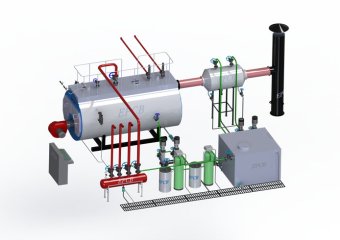
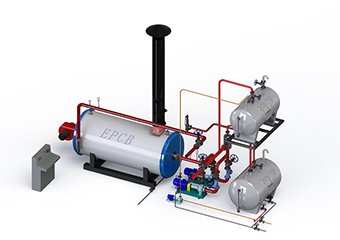
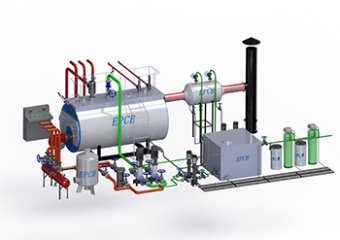
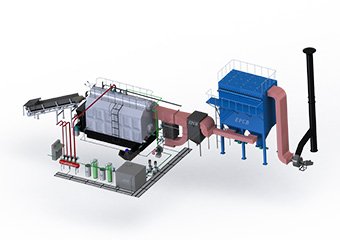
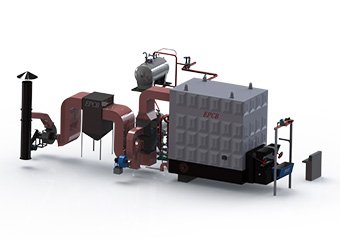
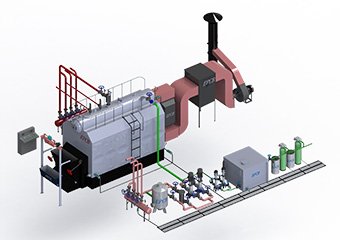
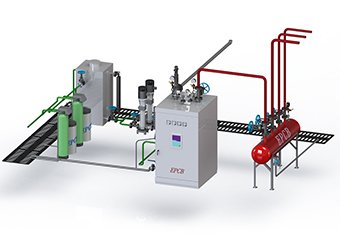
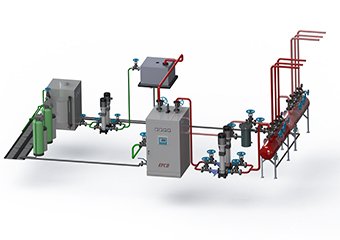





 Steam Boiler
 Thermal Oil Boiler
 Hot Water Boiler
 Steam Boiler
 Thermal Oil Boiler
 Hot Water Boiler
 Steam Boiler
 Thermal Oil Boiler
 Hot Water Boiler
 Steam Boiler
 Hot Water Boiler