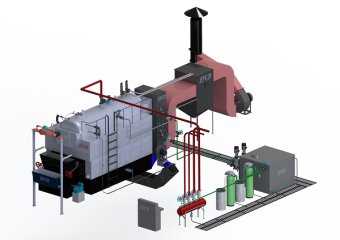
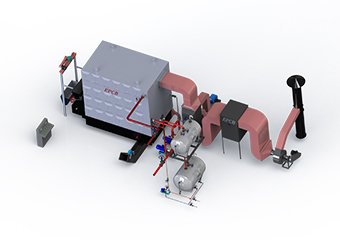
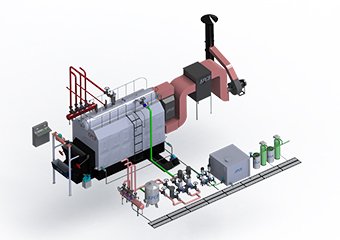
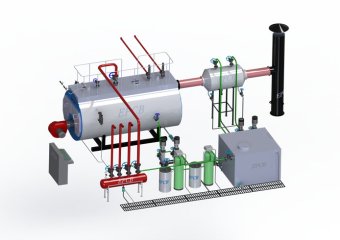
EPCB Boiler is a professional boiler manufacturer in China. Focus on industrial boiler production and sales for 68 years. Our main products are coal-fired boilers, oil gas boilers, biomass boilers, electric boilers, and power plant boilers.

Industrial boiler maintenance runs on three interval sets that follow different rules. Statutory inspection is set by your jurisdiction and insurer, safety-device testing by the control and boiler manufacturers, and condition-based servicing by fuel, feedwater chemistry, and load. Only the third set moves with operating conditions. A gas-fired steam boiler on treated make-up water can hold long fireside intervals. The same schedule on a biomass grate boiler leaves ash deposits that a stack thermometer detects months before an operator does. Separate the three first, then let stack temperature and water chemistry set the spacing on the third.
![]()
Three different rule sets govern how often an industrial steam boiler gets attention, and which one binds first depends on the boiler's pressure class, its jurisdiction, and the fuel it burns.
Task class | Typical starting point | Who sets the requirement |
Operator checks and logging | Each shift or daily while in service | Boiler OEM, plus local rules on attended and unattended operation |
Low water cut-off and water column testing | Manufacturer-specified; some float-type steam controls call for daily rather than weekly blowdown testing | Control manufacturer and boiler OEM, with a jurisdictional overlay |
Water chemistry sampling and blowdown | Per the site's water treatment program | Water treatment program limits and boiler OEM |
Combustion check and burner service | Planned periodic interval | Plant, measured against the approved burner combustion baseline |
Fireside and waterside cleaning | Condition-driven | Plant, from stack temperature and flue-gas pressure drop trends |
Pressure relief device inspection or testing | At the required interval and by the required method | Jurisdiction, OEM, and adopted NBIC provisions |
Varies by jurisdiction and boiler class | Jurisdiction and insurer |
Statutory inspection frequency is a legal input, not an engineering one. Requirements differ across jurisdictions and across boiler classes. The National Board publishes NB-370, a jurisdiction-by-jurisdiction synopsis compiled from what the jurisdictional authorities themselves report. Its standing advice is to confirm with that jurisdiction's chief inspection officer before making any decision with consequences.
The technical documents sit alongside that legal requirement. ASME's BPVC Section VII gives recommended guidelines for the care of power boilers, covering stationary industrial units while heating boilers fall under Section VI. National Board Inspection Code Part 2 addresses inspection of equipment already in service, and Part 4 covers pressure relief devices. The service contractor and the commissioned inspector are two different people signing two different documents.
Safety-device testing follows the control manufacturer and the boiler OEM. Some float-type low water cut-offs on steam service call for daily blowdown testing rather than weekly, depending on operating pressure and water quality. Probe-type controls are not blowdown-tested at all. What stays consistent is the failure mode. When a cut-off is "tested" by pressing a reset button instead of proving the burner shuts down as the level falls, a silted float chamber passes every test until the day it has to trip a burner.
When we hand a boiler over, we align the operator's daily sheet with the trip points actually programmed into that unit's controls and with the control maker's own test procedure. A check written against a generic set point proves very little.
![]()
Industrial boiler maintenance protects four failure paths that degrade on different clocks, and which path paces your schedule depends on fuel and feedwater quality. Those paths are the pressure boundary, the burner and level safety controls, the pressure relief devices, and heat-transfer and combustion performance.
Corrosion, erosion, and thermal cycling work on the pressure boundary slowly and irreversibly. Wall thinning does not show up in a daily walk-around, which is why internal inspection sits on its own interval. Ultrasonic thickness readings go with it where the inspector, the jurisdiction, prior condition history, or the plant's integrity program calls for them.
Burner and level safety controls fail differently. A low water cut-off or a flame safeguard can behave normally in service and still be unable to act when required. Only a test that exercises the mechanism, rather than the indication, proves otherwise.
Pressure relief devices form their own category and their own last line of pressure protection. NBIC handles them in a separate part, with inspection and testing provisions of their own.
Heat-transfer surfaces foul from both sides and produce the same symptom. On the waterside, calcium, magnesium, and silica form scale with roughly an order of magnitude less thermal conductivity than bare steel. For firetube boilers without stack-gas heat recovery such as economizers or air preheaters, the U.S. Department of Energy's Steam Tip Sheet #7 puts the resulting fuel increase at up to 5%. Soot and ash do the same job from the gas side, and here the fuel matters. A natural gas flame deposits almost no ash, while a biomass or coal flame deposits it continuously, so identical stack temperature readings on the two boilers point at opposite surfaces.
Combustion drift completes the set. The measurement that catches it is a combustion analysis compared against the approved burner curve, or against the site's validated baseline at the same firing condition.
![]()
Condition-based intervals on an industrial steam boiler are set by three inputs that have to converge together: fuel ash behavior, feedwater chemistry, and load pattern. None of the three overrides a statutory or OEM safety requirement.
Variable | Effect on the condition-based interval | Depends on |
Fuel ash and alkali content | Higher ash shortens fireside cleaning and ash handling intervals; low-ash gas shifts the binding constraint toward the waterside | Fuel spec variability, grate or burner type, furnace exit gas temperature |
Feedwater hardness, silica, and alkalinity | Weak pretreatment accelerates scale and brings the descaling outage forward | Make-up rate, softener or RO performance, dosing control |
Condensate return fraction | Lower return raises make-up volume and with it the mineral, oxygen, and treatment load | Whether pretreatment and deaeration absorb the extra make-up; trap condition; return line corrosion |
Load profile and cycling | Firing below the burner's minimum stable rate forces short cycling, which stresses refractory, gaskets, and tube-to-tubesheet joints | Turndown ratio, degree of oversizing, availability of standby capacity |
Attended or unattended running | Unattended operation removes the daily human check and moves that duty to instrumentation | Local attendance rules, alarm response arrangements |
Two variables have to be confirmed before the others are worth discussing: the fuel specification and the feedwater quality. Fuel is locked first, not because it outranks feedwater, but because the fuel decision is fabricated into the boiler. Grate design, furnace volume, access openings, and the ash removal route sit inside the pressure and furnace envelope, where later change is rarely economic. Feedwater quality can usually be improved after installation. Improvement may mean adding softening, reverse osmosis, deaeration, storage, or dosing equipment in the boiler house. Load profile and condensate return then adjust the interval inside the envelope those two define.
Sizing the cost of getting the water side wrong takes one line of arithmetic. For a firetube boiler without stack-gas heat recovery, roughly 1/32 inch of normal-composition scale carries about a 2% fuel penalty. On a hypothetical annual fuel spend of $600,000, that is on the order of $12,000 a year, several times the cost of the sampling discipline that prevents it. Substitute your own annual fuel spend to size your own case. Confirm first that your boiler matches those assumptions, because the percentage is tied to firetube geometry without heat recovery.
Choosing chemicals and dosing rates for that water treatment program is a separate exercise driven by your make-up water analysis, and it sits outside a maintenance schedule. What belongs in the schedule is how often you sample the result and which reading triggers action.
Worth saying plainly: for a single low-pressure boiler on one shift with a competent operator, a paper log and a correctly performed cut-off test will catch more than any monitoring package. Condition monitoring earns its cost mainly where units run unattended, run multiple shifts, or sit upstream of a line that stops when steam stops.
Before we propose a service interval, we verify feedwater hardness and the fuel's ash specification against the heating surface loading the boiler was designed for.
Two readings already sitting in most operator logs will show whether the cleaning interval on an industrial steam boiler has drifted too long, provided both are compared at matched firing rate and matched excess oxygen.
Stack temperature is the first. A steady upward trend at the same firing rate means heat that should be entering the water is leaving through the chimney. DOE's often-quoted approximation is that boiler efficiency improves by roughly 1% for every 40 °F reduction in stack gas temperature, or every 15% reduction in excess air. Treat that as a way to size the loss, not as a formula for predicting your own recovery.
A flat matched-load trend supports the current heat-transfer cleaning interval and only that. Localized thinning, refractory damage, relief valve degradation, cut-off failure, and waterside pitting are all invisible to a stack thermometer. Statutory and safety-device intervals therefore stay exactly where the jurisdiction and the OEM put them.
Attribution then splits by fuel. On a gas-fired unit, a rising stack temperature makes waterside fouling the stronger suspect, provided firing rate, excess oxygen, CO, burner condition, and any downstream economizer or air preheater are comparable. On a grate-fired biomass or coal boiler, the same reading puts fireside fouling first, with waterside scale second. One symptom, two starting points, chosen by what you burn.
Blowdown behavior is the second signal. If operators are blowing down more often to hold the same conductivity, either make-up volume has risen or pretreatment has degraded. Bring the descaling outage forward rather than wait for its calendar slot. Frequency and duration themselves come from the water treatment program and the OEM, since visibly clear discharge is a poor proxy for boiler water chemistry.
Where to open first is worth deciding from evidence. On grate-fired biomass boilers, deposition location shifts with ash composition, alkali and chlorine content, furnace exit temperature, and heating surface arrangement. Prior outage findings, flue-gas pressure drop, and sootblower performance usually identify the right section faster than a standard inspection sequence does.
No. Monitoring shortens the gap between a fault appearing and someone knowing about it, but no sensor removes scale, frees a seized valve, or measures wall thickness.
Seasonal boilers often need more attention, not less. An improperly laid-up idle boiler can corrode rapidly. Agree on a wet or dry lay-up procedure before shutdown, and confirm that the chosen method is maintained through the idle months.
Keep them at least until the next statutory inspection has been signed off, and longer where insurers, warranty terms, or local regulations set a period. Thickness readings are worth keeping for the life of the boiler. A single measurement means little; a trend across several outages means a lot.
Low load changes two things independently. Cold-end surfaces can approach the acid dew point as flue gas temperature falls, with the risk depending on fuel sulfur, moisture, and metal temperature. Short cycling is a separate effect that appears only once demand drops below the burner's minimum stable rate, so an oversized boiler reaches it sooner than a well-matched one.
Ask for a combustion analysis report with before-and-after figures, a signed record of safety-device and pressure relief device testing, and thickness readings where taken. Add a written list of defects with recommended timing. Verbal confirmation carries little weight at the next inspection.
Of the three interval sets, only one is yours to set. Statutory inspection belongs to the jurisdiction and the insurer, safety-device testing belongs to the control and boiler manufacturers, and what remains is the condition-based half of industrial boiler maintenance, decided by what the boiler burns and what enters it as feedwater. Confirming those two is what turns a schedule from a guess into a position you can defend to an inspector.
Expect that position to move. The first internal inspection shows how the surfaces are actually behaving under your fuel and your water, and until then the interval you started with is a hypothesis. Before proposing a service plan, we clarify which of the three interval sets a customer's insurer and local authority require, since the answer varies by jurisdiction more than most operators expect.
Where to begin depends on what is already written down. If you have twelve months of matched-load readings, plot stack temperature and excess oxygen at a repeated firing rate and read the trend: flat supports the cleaning interval you are already running, while a rising trend means the fireside or waterside needs opening before the calendar says so. If the log is thin or inconsistent, build the baseline first, because one combustion analysis and one stack temperature reading at a known load, properly recorded, are worth more than a year of arguing about frequency.
If the boiler is still being specified, the same two variables belong in the inquiry. Give the fuel's ash and moisture range, and state the access provisions the maintenance plan will depend on: cleaning doors, inspection openings, an ash removal route, and the blowdown arrangement. Those are built into the boiler, and retrofitting them after delivery is expensive at best, so they belong in the inquiry you send an industrial boiler manufacturer, well before a change order becomes the only option.
Send You Inquiry
Give You Boiler Solution
Place The Order
Get Your Boiler