
What Is a Tank Blowdown? How a Boiler Blowdown Tank Works

June 12, 2026

A tank blowdown is the controlled release of hot water and accumulated solids from a steam boiler into a blowdown tank, where the discharge is cooled and depressurized before it reaches a drain. The term causes confusion because "tank blowdown," "blowdown tank," and "boiler blowdown" describe related but separate things, and keeping them straight changes what equipment you need. You will also see "blowoff" used interchangeably with "blowdown" in codes and product literature. This guide explains what a tank blowdown is, why a boiler routes its discharge through a tank, how that tank works, and how we help operators choose and size one. It does not cover the layout and piping design of the blowdown line itself, which is a separate engineering step tied to your boiler room and your discharge routing.


What a Tank Blowdown Means in a Steam Boiler System


A tank blowdown is the act of discharging boiler water through a blowoff valve into a blowdown tank, and the volume and temperature involved depend on the boiler's operating pressure and how often the blowoff runs. The phrase points to the discharge event, not to a piece of equipment on its own.


Boiler blowdown is the broader practice behind it. Removing water from the boiler keeps dissolved and suspended solids under control, and operators do this two ways. Continuous surface blowdown skims off the dissolved solids that concentrate near the water surface, while intermittent bottom blowdown clears settled sludge from the mud drum. The blowdown tank, sometimes called a blowoff tank, is the vessel that receives whichever discharge the boiler sends.


We clarify this distinction at the outset because the right term points to the right equipment and the right code path. When a system is specified around the phrase rather than the function, we have seen separators ordered where local code required a tank, which means re-procuring the vessel before the boiler can be signed off.


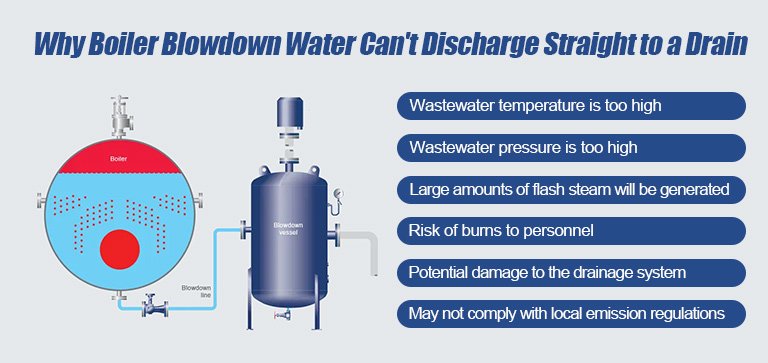
Why Boiler Blowdown Water Can't Discharge Straight to a Drain


Boiler blowdown water leaves the vessel at the saturation temperature of the boiler, so whether it can safely reach a drain depends on the operating pressure and the discharge limit set by local code. The higher the pressure, the hotter that water is.


Blowdown happens in the first place to protect the boiler. Feedwater carries dissolved and suspended solids that concentrate as steam leaves the system, and without regular removal they form scale and drive corrosion, both of which cut efficiency and shorten equipment life.


The water removed is dangerously hot, though. At an operating pressure near 100 psig it sits around 338°F, well above the boiling point at atmospheric pressure. Sent straight to a sanitary sewer, it flashes steam in the drain line and far exceeds the discharge limit many codes set, commonly about 140°F.


Many jurisdictions also treat boilers above 15 psig as high pressure and require a tank or separator on the blowoff. Before we approve any discharge arrangement, we verify the expected drain temperature against the governing code rather than assuming the standard limit applies everywhere.


How a Blowdown Tank Cools and Vents the Discharge


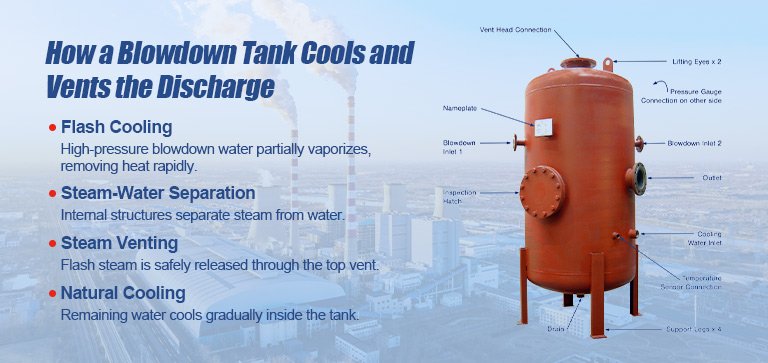
A blowdown tank cools the discharge by flashing part of the incoming hot water to steam and venting it, then holding the rest until it cools enough to drain, with the time that takes depending on tank volume and blowdown frequency. The vessel is built for this sudden, turbulent event.


When high-pressure water enters, the pressure drops and a portion of it instantly flashes to steam. An internal baffle or wear plate deflects the high-velocity incoming water, protecting the shell from erosion and helping the steam separate from the water.


The vent must be sized for the flash steam that blowdown generates, not by a simple rule that it is larger than the inlet. It connects at the highest point of the vessel and runs to a safe atmospheric discharge at full size, with no stop valve in the line. An undersized or restricted vent lets pressure build in a vessel meant for near-atmospheric service.


The water left behind cools by conduction and convection, and in a single-boiler intermittent bottom-blowdown application a correctly sized tank may cool passively without any cooling-water injection. Where blowdown is frequent, where consecutive blowdowns overlap, or where several boilers discharge to one vessel, an aftercooler or a controlled cold-water line may still be needed to hold the drain temperature down. An overflow drain set part way up holds the water until the next cycle pushes the now-cooled water out.


When we commission a system, we align the vent and drain sizing with the boiler's blowdown rate so the tank cools between cycles. On boilers running frequent intermittent blowdown, the vent line is the connection we check first, because an undersized vent lets flash steam back up and pressurize a tank that was only built for atmospheric conditions. Scale and sediment also settle out in the tank over time, so clearing the drain, cleanout, and any manway on a regular schedule keeps the outlet from clogging and the discharge temperature where it should be.

Choosing Between a Blowdown Tank and a Blowdown Separator

Choosing Between a Blowdown Tank and a Blowdown Separator


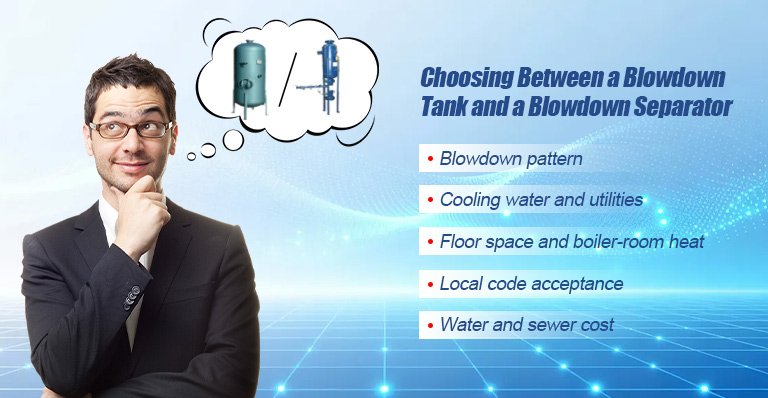
Choosing between a blowdown tank and a blowdown separator depends on your boiler's blowdown pattern, the floor space available, and whether your local code accepts a separator's cooling-water approach. Both cool and safely discharge blowdown, but they reach the result differently.


A separator is compact and uses a striking baffle to split steam from water, but it usually relies on an aftercooler injecting cooling water to bring the drain temperature down. A blowdown tank is larger and cools passively over time, so it often needs no cooling water for intermittent single-boiler service, settles sediment, and conserves water. The trade-offs are more floor space, a higher purchase price, and added heat radiated into the boiler room.


We compare the two against a few decision variables rather than defaulting to whichever is cheaper:


· Blowdown pattern: intermittent bottom blowdown suits a tank's hold-and-cool cycle, while sustained or frequent flow can favor a separator with active cooling.


· Cooling water and utilities: a separator needs a reliable tempering-water line and adds to your sewer load, whereas a tank often needs neither for single-boiler service.


· Floor space and boiler-room heat: a tank takes more room and warms the boiler room as it cools, which a tight or already-hot room may not tolerate.


· Local code acceptance: some jurisdictions mandate a tank and will not accept a separator, so the code can settle the question before cost does.


· Water and sewer cost: where water or sewer charges are high, a tank's lack of cooling water can offset its higher purchase price over time.


Because the answer shifts with the site and the code, the comparison is worth running for each installation rather than carrying a preference from one project to the next.


What Determines the Right Blowdown Tank Size


What Determines the Right Blowdown Tank Size


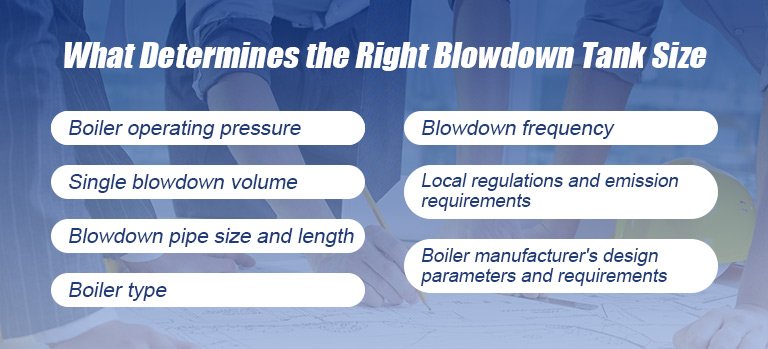
Blowdown tank size is set by how much hot water each blowdown releases and how fast it has to be handled, which depends on the boiler's operating pressure and the size and length of the blowoff line. Undersize the vessel and the discharge never cools enough to drain within code.


The current National Board guide for blowoff vessels, NB-27, bases sizing on the operating pressure and the blowoff line rather than a single fixed formula, and it reads as design guidance rather than a rule that fits every layout. A long-used rule of thumb, still seen in manufacturer charts, starts from about twice the water removed when the normal water level drops a set amount, often four inches. Doubling it gives the previous cycle time to cool before the next blowdown arrives.


How the displaced volume is figured also differs by boiler: for a firetube boiler it comes from the water-surface area at the normal level, for a watertube boiler from the steam-drum diameter. Two boilers with the same steam output can therefore call for different tank volumes.


The vessel itself is a pressure-rated component, not an open drum. NB-27 calls for a blowoff vessel built to ASME Section VIII, Division 1 for a maximum allowable working pressure of at least 50 psi, or to the boiler maker's requirements. A closed vessel, where one is used, should be rated to at least the boiler's own working pressure.


Because the guide does not cover every arrangement, we verify the sizing against the current NB-27 edition, the boiler manufacturer's data, and the limit your jurisdiction enforces, rather than carrying a tank size over from a similar-looking installation. When operators reuse a tank from a smaller boiler or skip the doubling, the discharge often still reaches the drain above the allowed temperature, and the fix is usually a larger vessel rather than a workaround.


Bringing the Blowdown Decision Together

Bringing the Blowdown Decision Together


A tank blowdown comes down to a few variables: the temperature and volume your boiler discharges, the cooling method your site can support, and the code your jurisdiction enforces. Settle those and the equipment choice usually follows.


In practice, the costliest mistakes we see come from carrying a tank size or equipment type across boilers without rechecking the displaced volume and the local discharge limit, which usually forces a retrofit. We compare the tank-versus-separator trade-off and verify sizing against your actual boiler, the current NB-27 guide, and your jurisdiction before anything is fabricated. That discipline prevents the retrofit an inherited tank size so often triggers, though the final figures still depend on confirmation at the project level, the boiler manufacturer's data, and the authority having jurisdiction.


If you are planning or upgrading a steam boiler, the useful next step is to have the details that drive sizing ready before you ask for a quote:


· Boiler type (firetube or watertube)

· Operating pressure and steam capacity

· Blowoff line size and blowdown frequency

· Drum or shell dimensions

· Number of boilers sharing one vessel

· Required drain-discharge temperature and the applicable jurisdiction


As an industrial steam boiler manufacturer, we can review those details and align the blowdown arrangement with your system and your code. Send us your boiler specifications to request a blowdown tank review.


What Is a Tank Blowdown? How a Boiler Blowdown Tank Works


A tank blowdown is the controlled release of hot water and accumulated solids from a steam boiler into a blowdown tank, where the discharge is cooled and depressurized before it reaches a drain. The term causes confusion because "tank blowdown," "blowdown tank," and "boiler blowdown" describe related but separate things, and keeping them straight changes what equipment you need. You will also see "blowoff" used interchangeably with "blowdown" in codes and product literature. This guide explains what a tank blowdown is, why a boiler routes its discharge through a tank, how that tank works, and how we help operators choose and size one. It does not cover the layout and piping design of the blowdown line itself, which is a separate engineering step tied to your boiler room and your discharge routing.


What a Tank Blowdown Means in a Steam Boiler System


A tank blowdown is the act of discharging boiler water through a blowoff valve into a blowdown tank, and the volume and temperature involved depend on the boiler's operating pressure and how often the blowoff runs. The phrase points to the discharge event, not to a piece of equipment on its own.


Boiler blowdown is the broader practice behind it. Removing water from the boiler keeps dissolved and suspended solids under control, and operators do this two ways. Continuous surface blowdown skims off the dissolved solids that concentrate near the water surface, while intermittent bottom blowdown clears settled sludge from the mud drum. The blowdown tank, sometimes called a blowoff tank, is the vessel that receives whichever discharge the boiler sends.


We clarify this distinction at the outset because the right term points to the right equipment and the right code path. When a system is specified around the phrase rather than the function, we have seen separators ordered where local code required a tank, which means re-procuring the vessel before the boiler can be signed off.


Why Boiler Blowdown Water Can't Discharge Straight to a Drain


Boiler blowdown water leaves the vessel at the saturation temperature of the boiler, so whether it can safely reach a drain depends on the operating pressure and the discharge limit set by local code. The higher the pressure, the hotter that water is.


Blowdown happens in the first place to protect the boiler. Feedwater carries dissolved and suspended solids that concentrate as steam leaves the system, and without regular removal they form scale and drive corrosion, both of which cut efficiency and shorten equipment life.


The water removed is dangerously hot, though. At an operating pressure near 100 psig it sits around 338°F, well above the boiling point at atmospheric pressure. Sent straight to a sanitary sewer, it flashes steam in the drain line and far exceeds the discharge limit many codes set, commonly about 140°F.


Many jurisdictions also treat boilers above 15 psig as high pressure and require a tank or separator on the blowoff. Before we approve any discharge arrangement, we verify the expected drain temperature against the governing code rather than assuming the standard limit applies everywhere.


How a Blowdown Tank Cools and Vents the Discharge


A blowdown tank cools the discharge by flashing part of the incoming hot water to steam and venting it, then holding the rest until it cools enough to drain, with the time that takes depending on tank volume and blowdown frequency. The vessel is built for this sudden, turbulent event.


When high-pressure water enters, the pressure drops and a portion of it instantly flashes to steam. An internal baffle or wear plate deflects the high-velocity incoming water, protecting the shell from erosion and helping the steam separate from the water.


The vent must be sized for the flash steam that blowdown generates, not by a simple rule that it is larger than the inlet. It connects at the highest point of the vessel and runs to a safe atmospheric discharge at full size, with no stop valve in the line. An undersized or restricted vent lets pressure build in a vessel meant for near-atmospheric service.


The water left behind cools by conduction and convection, and in a single-boiler intermittent bottom-blowdown application a correctly sized tank may cool passively without any cooling-water injection. Where blowdown is frequent, where consecutive blowdowns overlap, or where several boilers discharge to one vessel, an aftercooler or a controlled cold-water line may still be needed to hold the drain temperature down. An overflow drain set part way up holds the water until the next cycle pushes the now-cooled water out.


When we commission a system, we align the vent and drain sizing with the boiler's blowdown rate so the tank cools between cycles. On boilers running frequent intermittent blowdown, the vent line is the connection we check first, because an undersized vent lets flash steam back up and pressurize a tank that was only built for atmospheric conditions. Scale and sediment also settle out in the tank over time, so clearing the drain, cleanout, and any manway on a regular schedule keeps the outlet from clogging and the discharge temperature where it should be.


Choosing Between a Blowdown Tank and a Blowdown Separator


Choosing between a blowdown tank and a blowdown separator depends on your boiler's blowdown pattern, the floor space available, and whether your local code accepts a separator's cooling-water approach. Both cool and safely discharge blowdown, but they reach the result differently.


A separator is compact and uses a striking baffle to split steam from water, but it usually relies on an aftercooler injecting cooling water to bring the drain temperature down. A blowdown tank is larger and cools passively over time, so it often needs no cooling water for intermittent single-boiler service, settles sediment, and conserves water. The trade-offs are more floor space, a higher purchase price, and added heat radiated into the boiler room.


We compare the two against a few decision variables rather than defaulting to whichever is cheaper:


· Blowdown pattern: intermittent bottom blowdown suits a tank's hold-and-cool cycle, while sustained or frequent flow can favor a separator with active cooling.


· Cooling water and utilities: a separator needs a reliable tempering-water line and adds to your sewer load, whereas a tank often needs neither for single-boiler service.


· Floor space and boiler-room heat: a tank takes more room and warms the boiler room as it cools, which a tight or already-hot room may not tolerate.


· Local code acceptance: some jurisdictions mandate a tank and will not accept a separator, so the code can settle the question before cost does.


· Water and sewer cost: where water or sewer charges are high, a tank's lack of cooling water can offset its higher purchase price over time.


Because the answer shifts with the site and the code, the comparison is worth running for each installation rather than carrying a preference from one project to the next.


What Determines the Right Blowdown Tank Size


Blowdown tank size is set by how much hot water each blowdown releases and how fast it has to be handled, which depends on the boiler's operating pressure and the size and length of the blowoff line. Undersize the vessel and the discharge never cools enough to drain within code.


The current National Board guide for blowoff vessels, NB-27, bases sizing on the operating pressure and the blowoff line rather than a single fixed formula, and it reads as design guidance rather than a rule that fits every layout. A long-used rule of thumb, still seen in manufacturer charts, starts from about twice the water removed when the normal water level drops a set amount, often four inches. Doubling it gives the previous cycle time to cool before the next blowdown arrives.


How the displaced volume is figured also differs by boiler: for a firetube boiler it comes from the water-surface area at the normal level, for a watertube boiler from the steam-drum diameter. Two boilers with the same steam output can therefore call for different tank volumes.


The vessel itself is a pressure-rated component, not an open drum. NB-27 calls for a blowoff vessel built to ASME Section VIII, Division 1 for a maximum allowable working pressure of at least 50 psi, or to the boiler maker's requirements. A closed vessel, where one is used, should be rated to at least the boiler's own working pressure.


Because the guide does not cover every arrangement, we verify the sizing against the current NB-27 edition, the boiler manufacturer's data, and the limit your jurisdiction enforces, rather than carrying a tank size over from a similar-looking installation. When operators reuse a tank from a smaller boiler or skip the doubling, the discharge often still reaches the drain above the allowed temperature, and the fix is usually a larger vessel rather than a workaround.


FAQ


Is a tank blowdown the same as boiler blowdown?

A tank blowdown refers to the discharge event into the blowdown tank, while boiler blowdown is the broader practice of removing water to control dissolved solids. The blowdown tank is the vessel that receives that discharge. The terms describe related steps in one system rather than the same thing.


Why does blowdown water flash into steam in the tank?

Blowdown water flashes because it enters the tank at the boiler's saturation temperature and meets a sudden pressure drop. At the lower pressure the water is hotter than its new boiling point, so part of it turns to steam at once. The tank vents that steam safely and holds the rest to cool.


Does a blowdown tank need cooling water?

A blowdown tank often needs no cooling water for a single boiler on intermittent bottom blowdown, where a correctly sized vessel cools passively between cycles. Frequent blowdown, overlapping cycles, or several boilers sharing one vessel can require an aftercooler or a controlled cold-water line. Whether cooling water is needed depends on blowdown frequency and the number of boilers served.


How is a blowdown tank sized?

A blowdown tank is sized from the boiler's operating pressure and the size and length of the blowoff line, following the current NB-27 guide. A long-used rule of thumb starts from about twice the water removed in one blowdown cycle. Confirm the figure against the current edition, the manufacturer's data, and your jurisdiction before specifying a vessel.


Is a blowdown tank required by code?

A blowdown tank or separator is commonly required on high-pressure boilers, but whether a tank specifically is mandatory depends on your jurisdiction. Some local codes require a tank and will not accept a separator. Verify the requirement with the authority having jurisdiction.


How hot can blowdown water be when it reaches the drain?

Blowdown water usually has to be cooled to about 140°F or lower before it enters a drain, which is a common code limit. A correctly sized tank reaches that temperature through passive cooling between cycles, or with aftercooling where the duty is heavier. The exact limit depends on local code.

  • Send You Inquiry

  • Give You Boiler Solution

  • Place The Order

  • Get Your Boiler

Ask for Boiler Solution Suited Your Condition!

Tell us your need about boiler capacity in your industry, we will recommend the most suitable boiler model for you!

Consult online customer service
Product:
Boiler fuel: