What Is a Boiler Feed Pump? Function, Types, and How to Match One to Your Boiler

June 22, 2026

A boiler feed pump decides whether your steam supply stays continuous or stalls under load. It sits between the feedwater tank or deaerator and the boiler drum, pushing treated water in against the pressure the boiler already holds. When you size or troubleshoot one, the questions that matter are rarely "what is it" alone — they are how much water, at what pressure, at what temperature, and against what suction conditions.


This guide explains what a boiler feed pump does, how it works, the main types in service, and the variables that determine which one actually fits your boiler. As an industrial boiler manufacturer, we specify and match feed pumps to boiler duty on a regular basis, so the focus here is on the decisions that prevent problems rather than on theory.


What a Boiler Feed Pump Does in a Steam System


A boiler feed pump is a high-pressure pump that delivers feedwater from a storage tank or deaerator into a pressurized boiler, and its required output depends on the boiler's evaporation rate and operating pressure. Its job is to replace the water that leaves the boiler as steam, so the drum level stays within a safe band while the boiler is firing.


The pump does three things in sequence: it draws water from the suction source, raises that water above the boiler's internal pressure, and delivers it at a flow that tracks steam demand. Run delivered flow higher than evaporation and you get energy waste and level swings; run it lower and steam output drops, letting the drum fall toward a low-water condition. We size feed pumps to match delivered flow and head to the boiler's rated evaporation, not to a generic catalog point, because a mismatch here shows up as instability everywhere downstream.


Why Feed Pump Selection Is Not Just About Matching Boiler Pressure


The most common selection mistake is treating a feed pump as a pressure problem alone, when suction-side conditions decide reliability just as much as discharge pressure. A pump can be rated well above boiler pressure and still fail in service if the water reaching its suction is too hot or the available suction head is too low.


Feedwater is often near boiling. When feedwater temperature climbs and the available NPSH at the suction is not verified against what the pump requires, the first symptom is usually cavitation — and the inlet stages of a multistage pump tend to show damage first. The fix is rarely a bigger motor. It is correcting suction temperature, static head, or the booster arrangement. We verify required suction conditions against the installed layout before confirming a feed pump, rather than assuming a pump that "makes the pressure" will survive the duty.


How a Boiler Feed Pump Moves Water Into a Pressurized Boiler


A boiler feed pump builds discharge pressure higher than boiler pressure through one or more impeller stages, and the number of stages depends on the head that boiler requires. Water enters the suction, each rotating impeller adds kinetic energy that the casing converts to pressure, and stacking impellers in series lets the pump reach pressures a single stage could not.


The pump must always overcome the steam pressure the boiler is developing, so it has to generate more head than the boiler's working pressure plus piping and control losses. Many feed pumps also run continuously and rely on a minimum-flow path back to the tank or deaerator to avoid overheating at low demand. We confirm that the minimum-flow protection matches the pump's low-flow limit, because losing that path is one of the quieter ways a feed pump cooks itself during turndown.


Main Types of Boiler Feed Pumps and When Each Fits


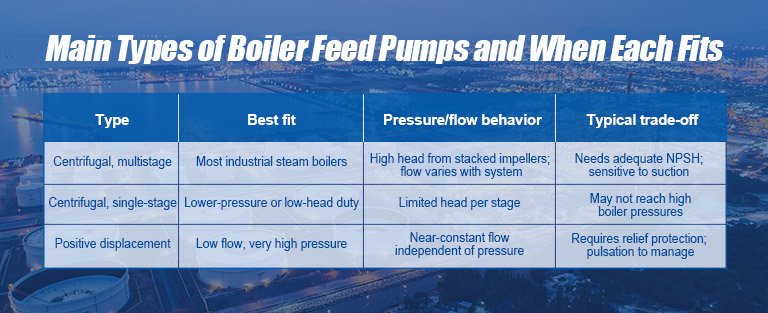
Most modern boiler feed pumps are centrifugal pumps, and multistage centrifugal designs dominate duty in industrial steam boilers because they deliver high, steady pressure at the flows these plants need. Positive displacement pumps appear in narrower cases — small-flow, very-high-pressure service, older steam systems, or duties needing a near-constant flow regardless of pressure. The right choice follows the flow and pressure profile of the boiler, not habit.


Type

Best fit

Pressure/flow behavior

Typical trade-off

Centrifugal, multistage

Most industrial steam boilers

High head from stacked impellers; flow varies with system pressure

Needs adequate NPSH; sensitive to suction conditions

Centrifugal, single-stage

Lower-pressure or low-head duty

Limited head per stage

May not reach high boiler pressures

Positive displacement

Low flow, very high pressure

Near-constant flow independent of pressure

Requires relief protection; pulsation to manage


Within the centrifugal family, multistage designs are the workhorse — several impellers in series build the pressure a boiler needs, and the shaft usually rests on bearings at both ends. We compare the boiler's required head and flow against each type's behavior before recommending one, so the pump is chosen on duty rather than on familiarity.


Key Variables That Decide Which Feed Pump Matches Your Boiler

Feed pump selection turns on a small set of duty variables, and skipping any one of them is what turns a "rated" pump into a problem pump. Each variable maps directly to a part of the pump's specification, so they are worth verifying as a checklist rather than estimating.


· Required flow rate — set by the boiler's maximum evaporation, usually with a margin so the pump can recover drum level after a demand spike.


· Required head/pressure — boiler working pressure plus losses across piping, valves, and the economizer; this drives stage count.


· Feedwater temperature — high inlet temperature lowers available NPSH and pushes the design toward better suction conditions or a booster pump.


· Available NPSH at suction — set by the installation (liquid level, suction-line losses, pressure, and water temperature), it must stay above the pump's required NPSH from its curve, which itself rises with flow. Design for margin, not a bare match.


· Control method — continuous-run with minimum-flow recirculation, on/off, or variable-speed, each one changing how the pump is protected and sized.


These variables interact. Raising feedwater temperature for efficiency, for example, tightens the suction-side margin you have to design around. Selection should also be checked against the governing boiler code. In ASME Section I applications, pump discharge capability and the feedwater supply arrangement are assessed in relation to the boiler's safety valve setting and the applicable supply provisions — but the exact requirement depends on boiler type, heat source, and local code, so it is verified per project rather than assumed. We align flow, head, temperature, and suction data into a single duty point and check it against the pump curve and the relevant code, so the selection holds up under real operating swings.


Common Feed Pump Failures and How to Prevent Them


Most boiler feed pump failures trace back to a handful of conditions, and nearly all of them are preventable at the design and operation stage rather than at repair. Catching the pattern early is usually the difference between an adjustment and a rebuild.


Cavitation from insufficient suction head or excessive feedwater temperature attacks the inlet stages first and is the most frequent root cause in this service. Running a pump below its minimum flow for long periods overheats the liquid inside and damages internals. Mechanical seals on feed pumps can also wear under the low conductivity of boiler-grade water, which is why seal and material selection depends on feedwater temperature and water chemistry rather than a default spec. We trace recurring faults back to flow, suction, or seal conditions before swapping parts, because replacing a pump without correcting the underlying duty just resets the clock on the same failure.


Bringing It Together: Matching the Pump to the Boiler


Choosing a boiler feed pump comes down to four linked variables — flow, head, feedwater temperature, and available suction — not to discharge pressure on its own. A pump that satisfies every one of these at the real duty point keeps steam generation continuous and the pump itself out of the repair shop.


In practice, we weight suction conditions and minimum-flow protection as heavily as discharge pressure, because those are where "correctly rated" pumps most often come undone. Some parts of any selection stay project-specific: the exact head depends on your piping and economizer losses, the suction design depends on your feedwater temperature and tank arrangement, and the governing code depends on your jurisdiction — all of which we confirm against the installed system before finalizing a recommendation.


If you are matching a feed pump to a new or existing boiler, the next step is to gather a few data points so the duty can be verified:


· Boiler capacity (kg/h or lb/h) and working pressure

· Safety valve setting

· Feedwater temperature

· Deaerator or feed tank height above the pump, and suction line layout

· Control method (on/off, modulating valve, or VFD)

· Applicable code (ASME, EN, or local boiler code)


With those in hand, we can verify a suitable pump duty and flag anything in the suction design that needs attention. Contact our team to submit your boiler details for a feed pump review.


FAQ


What is the difference between a boiler feed pump and a condensate pump?

A condensate pump returns condensed steam from the condenser to the feed tank or deaerator at relatively low pressure, while the feed pump raises that water above boiler pressure to push it into the drum. In some installations one pump can serve both roles, but the defining feature of a feed pump is the high discharge pressure it must generate against the boiler.


Why are most boiler feed pumps multistage?

Multistage construction lets the pump reach the high pressures a boiler needs, because each impeller adds only a limited amount of head. Several impellers in series on one shaft build the discharge pressure that a single stage could not reach on its own.


How much pressure does a boiler feed pump need to generate?

The pump must generate more pressure than the boiler's working pressure plus all losses in the piping, valves, and economizer between the pump and the drum. The exact figure depends on the boiler's design pressure and system layout, which is why it is verified per installation rather than assumed.


What is NPSH in a boiler feed pump?

NPSH describes the suction-side pressure margin that keeps feedwater from vaporizing at the pump inlet. The available NPSH set by the installation must stay above the pump's required NPSH from its curve, with margin — a condition that gets harder to meet as feedwater temperature rises, which is why hot feedwater is a frequent cause of cavitation.


Does a boiler feed pump need minimum-flow recirculation?

A continuously running feed pump usually does, because operating below its minimum flow overheats the liquid trapped inside the pump. A recirculation path back to the tank or deaerator protects the pump during low-demand periods; if that path fails, the pump can overheat even when discharge pressure still looks normal.

  • Send You Inquiry

  • Give You Boiler Solution

  • Place The Order

  • Get Your Boiler

Ask for Boiler Solution Suited Your Condition!

Tell us your need about boiler capacity in your industry, we will recommend the most suitable boiler model for you!

Consult online customer service
Product:
Boiler fuel: