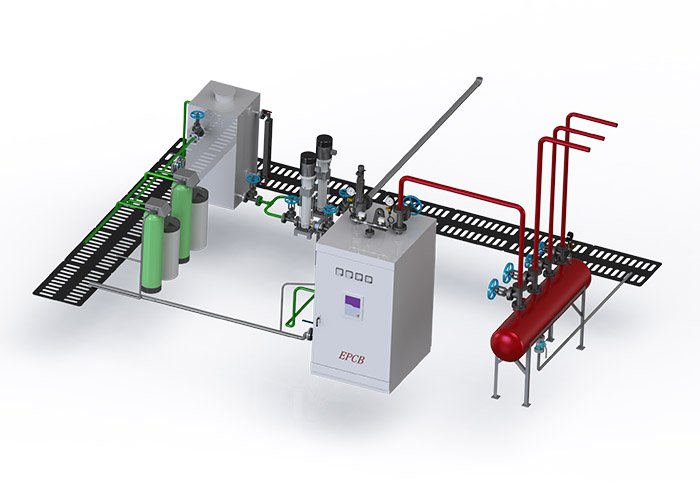
Palm Oil Mill Boiler System: Steam, Power and Fuel Balance

October 30, 2026

In most palm oil mills, one biomass-fired boiler plant supplies all process steam and, through a back-pressure turbine, part or all of the electricity, burning the mill's own fiber and kernel shell. Sizing a palm oil mill boiler system means closing three balances together: steam per tonne of fresh fruit bunches (FFB), power per tonne of FFB, and the heat in the mill's residues. Boiler pressure depends mainly on how much power the turbine must deliver. The sterilizers themselves need only about 3 bar(g). Capacity follows FFB throughput and sterilizer scheduling, and the fiber-to-shell ratio decides how much shell is left to sell.


Mill parameter

Reference value and source

Process steam demand

350–500 kg per tonne FFB (Boilers for Palm Oil Mills: Recent Trends, GREPALMA 2016 conference presentation)

Boiler selection capacity

450–600 kg per tonne FFB, including deaerator steam (same presentation)

Sterilizer steam

40 psig (about 2.8 bar(g)) for 60–90 minutes (AOCS Lipid Library, Palm Oil, MPOB)

Boiler pressure tiers shown

21, 31, 41–45 and 65 bar(g); older mills about 21 bar(g) at 250 °C (presentation; reference designs, not an industry standard)

Mill electrical load

About 21 kW per t FFB/h of throughput, roughly 21 kWh per tonne FFB, crude palm oil mill only (presentation)

Feedwater temperature

105–120 °C after the deaerator, set by deaerator pressure; the upper end helps against sulphur corrosion (presentation)

Boiler efficiency, 21 bar(g) reference design

About 63% on HHV, flue gas near 300 °C (presentation)


What a Palm Oil Mill Boiler System Includes


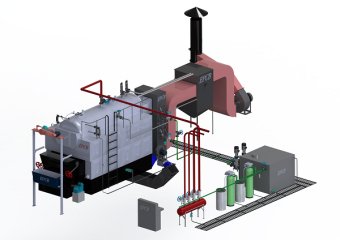
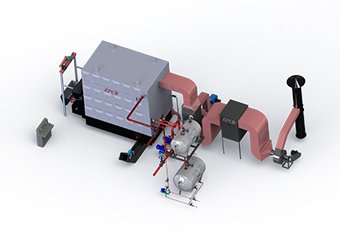
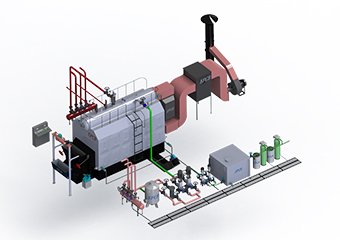
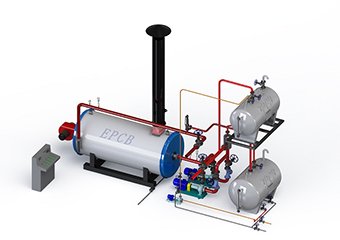
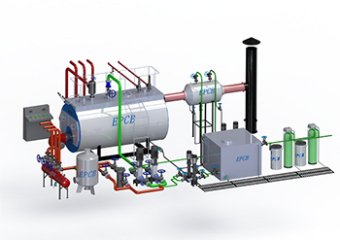
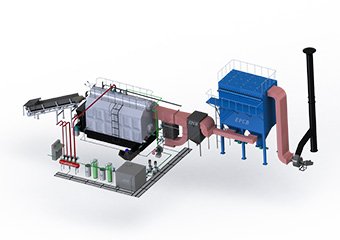
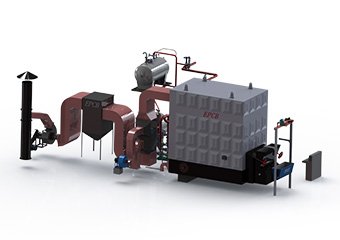
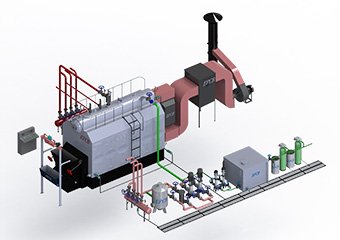
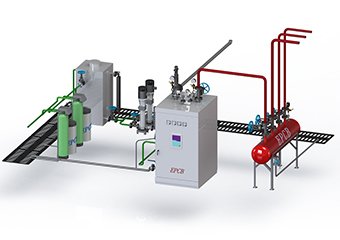
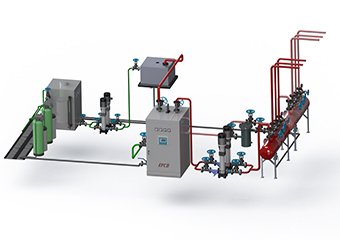
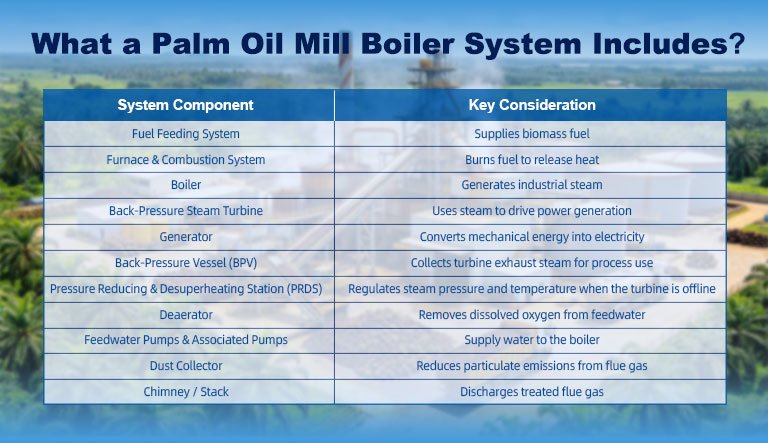
A palm oil mill boiler system covers everything between the fuel conveyor and the sterilizer inlet, and in a self-powered mill the turbine sits in the middle of it. The main parts are the fuel feed and furnace, the boiler, a back-pressure turbine and generator, the back-pressure vessel (BPV) that collects turbine exhaust, the deaerator and feed pumps, and the dust collector and stack.


When the turbine is unavailable, a bypass station keeps the low-pressure header supplied. Throttling through a valve is close to constant enthalpy, so superheated boiler steam stays superheated downstream. Where the boiler delivers superheated steam, the bypass usually needs both pressure reduction and desuperheating (a PRDS). Size it for full process flow and feed it with spray water of boiler-feed quality. This is why a quote for "a 20 t/h biomass boiler" says little until the turbine inlet conditions, BPV pressure and bypass duty are written down.


Why Boiler Pressure Follows the Mill's Power Plan


Boiler pressure in a palm oil mill depends mainly on how much electricity the back-pressure turbine must produce, because every process user downstream runs on about 3 bar(g) exhaust steam. Reasoning from the sterilizer alone is the common mistake. If the hottest user needs 2.8 bar(g), a 10 bar(g) boiler looks generous. For a self-powered mill, it leaves the turbine almost no working range.


Steam tables give the theoretical ceiling. Assume the turbine exhausts at about 3 bar(g) and all process steam passes through it. On IAPWS-IF97 properties, with the outlet at 4.0 bar absolute, the ideal (isentropic) enthalpy drop is about 185 kJ/kg from 10 bar(g) saturated steam. It rises to about 325 kJ/kg from 21 bar(g) at 250 °C and about 435 kJ/kg from 31 bar(g) at 330 °C. Multiplied by 350–500 kg of process steam per tonne FFB, the ideal ceiling is about 18–26 kWh per tonne FFB at 10 bar(g), 32–45 kWh at 21 bar(g), and 42–60 kWh at 31 bar(g).


Against a load of about 21 kWh per tonne FFB, the 10 bar(g) case needs a turbine-generator converting 82–117% of the ideal drop. The low-steam end (117%) is thermodynamically impossible. The high-steam end (82%) is far beyond what a small back-pressure set achieves. At 21 bar(g) the requirement falls to about 47–66% of ideal, which is still demanding. Practice sits well below theory. For a 30 t FFB/h mill, the presentation's indicative multi-stage turbine figures are about 400 kWe at 21 bar(g)/250 °C, 900 kWe at 31 bar(g)/330 °C and 1,350 kWe at 45 bar(g)/410 °C. The load at 21 kW per t FFB/h is roughly 630 kWe. In that reference, self-sufficiency starts near 31 bar(g).


Two conclusions follow. First, self-power is decided by the turbine's guaranteed steam rate and net output at the chosen inlet conditions, so pressure should be fixed together with the turbine offer. Second, the more steam-efficient the process becomes, the less exhaust flows through the turbine, so a mill cutting process steam toward 350 kg/t FFB needs higher pressure, not lower, to stay self-powered. Turbine selection itself, from stage count to grid synchronization, belongs to a separate engineering review. Where the mill buys power cheaply and has no export plan, a process-only boiler at 10–15 bar(g) with no turbine is usually the simpler system, subject to steam distribution design.


Sizing Mill Boilers From FFB Throughput and Sterilizer Peaks


Mill boiler capacity starts from FFB throughput multiplied by 0.45–0.6 t of steam per tonne FFB, then gets checked against sterilizer scheduling, because batch sterilizers draw steam in surges. On that basis a 30 t FFB/h mill needs about 13.5–18 t/h of boiler capacity and a 45 t FFB/h mill about 20–27 t/h. The presentation's nominal reference point is 0.5 t/h of boiler capacity per t FFB/h, higher when power is exported.


Sterilization cycles explain much of the spread. The AOCS chapter reports sterilizer steam use rising from 140 kg per tonne FFB for a single-peak cycle to 224 kg for a triple-peak cycle, a 60% increase from cycle choice alone. When a mill sizes its boiler on average steam and lets several sterilizers fill at once, the usual symptom is BPV pressure sagging during the fills, seen as longer cooking times and poorer fruit stripping. Assess peak demand together with BPV storage, allowable pressure swing, boiler load response and sterilizer scheduling, instead of adding it straight onto continuous capacity. The margin is thin. About 3 bar(g) at the BPV against 2.8 bar(g) at the sterilizer leaves little room for piping and valve losses.


Unit count is a separate decision. One large boiler can cover the duty; the presentation's case examples run from 30 to 60 t/h per unit. Two smaller units let one boiler come off line for tube inspection while the other carries reduced throughput, at the cost of more capital and lower efficiency at part load. Whether N+1 is worth it depends on how long fruit can wait during an outage. For reference, EPCB's biomass steam boilers cover 1–25 t/h at 1.0–2.5 MPa(g) per unit.


Fiber, Shell and EFB as Mill Boiler Fuel

Palm mill boiler fuel comes from three residues with very different moisture, heating value and ash behavior, and the fiber-to-shell split sets both boiler efficiency and how much shell is left to sell. The figures below are per tonne of FFB on an as-fired basis, from the GREPALMA presentation; ash temperatures are reported sample values, not fixed properties.


Residue

Yield per t FFB

Moisture

HHV

Ash initial deformation (sample)

Firing implication

Mesocarp fiber

about 130 kg

about 39%

about 2,800 kcal/kg

about 1,120 °C

Base fuel; high moisture limits furnace temperature

Kernel shell

about 60 kg

about 14%

about 4,390 kcal/kg

about 1,070 °C

Swing fuel; dense and dry, often sold off-site

EFB, raw

about 230 kg

70–75%

about 1,225 kcal/kg

about 930 °C

Not fired raw

EFB, prepared

about 115–138 kg after dewatering to 50%

below 50%

above 2,200 kcal/kg (target)

about 930 °C

Optional, separately engineered fuel; alkali and chlorine raise slagging risk and cap steam temperature


An illustrative fuel balance shows why shell is the swing fuel. Steam at 21 bar(g) and 250 °C from 105 °C feedwater carries about 2.45 GJ of useful heat per tonne. At 0.45–0.6 t of steam per tonne FFB and the reference 63% efficiency on HHV, the boiler needs about 1.75–2.34 GJ of fuel per tonne FFB. Fiber supplies about 1.52 GJ (130 kg × 2,800 kcal/kg), so fiber alone falls short across the range. Covering the gap takes about 12–44 kg of the 60 kg of shell, leaving roughly 16–48 kg per tonne FFB to sell. At an assumed 75% efficiency the same steam needs 0–24 kg of shell, which shows how strongly efficiency drives shell sales. Put your own steam figure, efficiency and measured heating values into the same boiler fuel consumption calculation before committing shell contracts; start-up losses, extra blowdown and fuel variation are not included here.


EFB yields must be adjusted to the moisture basis used in the balance: dewatering 230 kg of raw EFB to 50% moisture keeps the dry solids but leaves only about 115–138 kg of as-fired fuel. The presentation's preparation limits are below 50% moisture with 95% of pieces under 50 mm. A boiler designed for fiber and shell should not be assumed to accept EFB later, because EFB needs a taller furnace, a reciprocating grate and wider superheater tube spacing, all fixed at the design stage.


Residue fuel only exists once fruit is being processed, so the start-up and backup plan belongs in the fuel design. The boiler needs a way to raise steam before the first fiber arrives and to hold pressure if the fiber conveyor stops: stored shell, a separate oil burner, a standby boiler or a reserve fuel bunker. Each option changes storage volume, burner management and controls. Fuel samples sent to bidders should also show the condition at the feeder, including particle size, sand and stones carried in with fiber, and tramp metal, because the feeder and grate must handle them.


Furnace, Grate and Dust Collection for Palm Residues


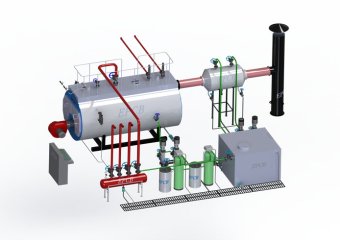
Grate type and furnace size for a palm oil mill boiler follow from the fuel mix and the dust limit as much as from the steam rating. Fiber and shell burn well on chain or reciprocating grates in bi-drum water tube boilers with generous furnace volume. The extra volume gives wet fiber time to dry and keeps furnace exit gas away from the ash softening range, about 1,130–1,180 °C in the reported shell and fiber samples. Because ash melting varies with ash chemistry, design margins should come from the mill's own fuel tests, including potassium and chlorine, rather than from one furnace exit temperature. Fire tube shell boilers suit small mills and oil- or gas-fired standby, but their pressure range and small furnaces limit them once turbine pressure and wet fiber both enter the design.


Uncontrolled flue gas from palm residues carries about 8–9 g/Nm³ of particulate, so dust collection belongs in the boiler package. Indicative outlet values in the presentation, all referenced to 10% O₂, are about 400 mg/Nm³ for a multicyclone, 100 mg/Nm³ for a wet scrubber and 50 mg/Nm³ for an ESP or bag filter. These are reference performance figures, not guarantees; before comparing them with a local limit, convert both to the same oxygen reference and dry or wet basis. The collector chosen then sets the induced draft fan through its draft loss, about 80 mm water column for a multicyclone and 150–200 mm for a bag filter.


Palm Mill Steam Terms That Distort Quotes

Several terms in palm oil mill boiler quotes are used loosely, and each can shift a sizing or fuel figure by tens of percent if it is not pinned down.


Term or phrase

What it means in context

Specification action

"30 ton boiler" vs "30 ton mill"

Boiler output in t/h of steam vs mill throughput in t FFB/h

Write both with units: t/h steam and t FFB/h

psig, bar(g), MPa

Sterilizers are often quoted at 40 psig, boilers in MPa, turbines in bar(g)

Convert all pressures to bar(g) on one data sheet (40 psig ≈ 2.8 bar(g); 2.5 MPa(g) ≈ 25 bar(g))

Calorific value of fiber

Dry-basis values near 19 MJ/kg vs as-fired near 11.7 MJ/kg at 39% moisture

State the moisture basis next to every heating value; test calorific value to ISO 18125 and moisture to ISO 18134 for solid biofuels

Boiler efficiency

HHV-basis and LHV-basis efficiency differ widely for wet fuels

Ask which basis the guarantee uses, at what fiber moisture, and which test method (for example ASME PTC 4)

Shell, PKS, cascara

Same material: palm kernel shell

Use one name in fuel analyses and contracts


Checking the Steam, Power and Fuel Balance Before a Mill Boiler Quote

Design pressure, steam temperature, fuel range and rated capacity of a palm oil mill boiler system are frozen together at detailed design. Pressure and fuel range are the least reversible, because drum, tubes, furnace and turbine are all built around them. Lock those two first. Before asking for prices, check these figures against the mill's own records:


1. FFB throughput, current and planned, in t FFB/h, plus annual operating hours

2. Process steam per tonne FFB, with the sterilization cycle type and the sterilizer filling schedule

3. Electrical load and whether the mill will import, balance or export power

4. Turbine inlet pressure and temperature, guaranteed steam rate and net output, BPV pressure and PRDS duty

5. Fiber and shell yields, moisture and heating value on a stated basis, plus planned shell sales

6. Whether EFB will be fired, now or later, with its prepared moisture and size

7. Ash fusion, potassium and chlorine results for the actual fuel (ash melting to ISO 21404)

8. Dust limit in mg/Nm³ with its oxygen reference, and the makeup water source and target blowdown rate

9. Condensate streams that can return to the feedwater system, with any that may carry oil or cleaning chemicals kept apart until tested, and the makeup demand left after returns


Ask also what a boiler-only quotation leaves out, such as fuel conveying, water treatment, ductwork, electrical work and commissioning, so offers are compared on the same scope.


When we review a palm mill enquiry, we check these figures against each other first. A fuel balance that does not close usually points to an optimistic steam figure. If the balance shows a process-steam or partial-generation duty within 25 bar(g), the EPCB Boiler For Palm Oil Plant page lists the matching biomass designs. If self-power or export needs 31 bar(g) and above, settle the turbine guarantee first and size the boiler to it. 


  • Send You Inquiry

  • Give You Boiler Solution

  • Place The Order

  • Get Your Boiler

Ask for Boiler Solution Suited Your Condition!

Tell us your need about boiler capacity in your industry, we will recommend the most suitable boiler model for you!

Consult online customer service
Product:
Boiler fuel: