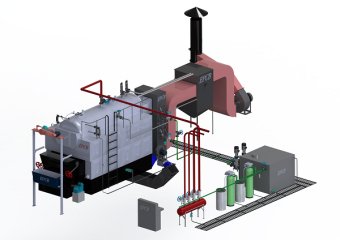
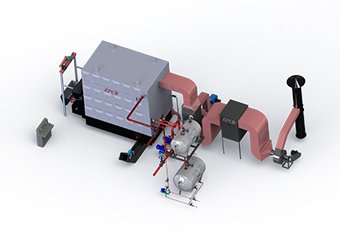
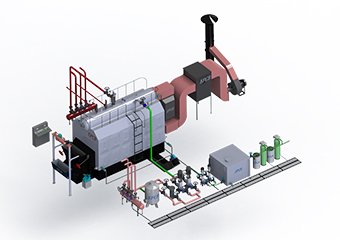
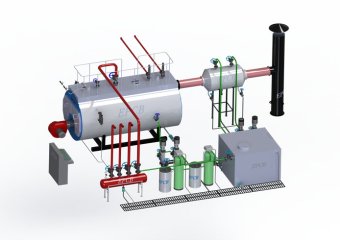
EPCB Boiler is a professional boiler manufacturer in China. Focus on industrial boiler production and sales for 68 years. Our main products are coal-fired boilers, oil gas boilers, biomass boilers, electric boilers, and power plant boilers.

Boiler fuel consumption calculation divides the useful heat a boiler delivers by the product of its efficiency and the fuel's calorific value: fuel rate = useful heat ÷ (η × CV). For a steam boiler, useful heat is steam flow multiplied by the enthalpy rise from feedwater to outlet steam. Three inputs move the answer more than most reference tables admit. The first is feedwater temperature at the boiler inlet; the second is whether efficiency and calorific value share the same gross or net basis; the third is how far below rated load the boiler runs. Pin those down and the formula returns an hourly figure a fuel meter can confirm or contradict.
![]()
The formula for boiler fuel consumption calculation applies to steam, hot water and thermal oil boilers alike: fuel rate = useful heat output ÷ (boiler efficiency × fuel calorific value). It holds only when efficiency and calorific value share one heating-value basis and one boundary. Every other step in an estimate exists to get those three terms right, because a wrong input flows straight into the fuel budget.
Units are where most published examples go wrong. Dividing kilowatts by kJ/kg returns kilograms per second, so the result must be multiplied by 3,600 to give kg/h. Skip that step and hourly fuel use comes out 3,600 times too small.
The efficiency term is the quantity defined by ASME PTC 4-2013 (Fired Steam Generators), the performance test code for coal-, oil- and gas-fired steam generators, reaffirmed in 2023. PTC 4 sets out how efficiency is tested: from measured input and output, or by subtracting individual heat losses. It is a test code, not a design or certification code. A datasheet efficiency should therefore state its method and load point, and whether the economizer and blowdown sit inside its boundary.
Input | Where the value should come from | What it depends on |
Steam flow (kg/h) | Process demand or a steam flow meter, not the nameplate rating | Actual production schedule |
Outlet steam enthalpy | Steam tables at operating pressure (plus temperature if superheated, dryness if wet) | Operating pressure and steam state |
Feedwater enthalpy | Steam tables at the feedwater temperature where the efficiency boundary begins | Condensate return, deaerator, economizer position |
Boiler efficiency (η) | Datasheet guarantee or a PTC 4 test | Load point, excess air, heating-value basis, boundary |
Fuel calorific value | Supplier certificate or laboratory analysis | Gross or net basis; moisture for solid fuels |
Blowdown rate | Water-treatment target (cycles of concentration) | Feedwater quality |
![]()
The "1 t/h of steam ≈ 0.7 MW" shortcut in steam boiler fuel estimates holds only near one boiler-inlet feedwater temperature at a given pressure, because each kilogram of steam carries less useful heat when the water enters the boiler warmer. FangKuai Boiler's FAQ, for example, treats the output of a 1-ton boiler as a fixed 600,000 kcal/h. That number hides an assumption.
Standard steam tables show its size. Dry saturated steam at about 10 bar g carries roughly 2,781 kJ/kg. With 20 °C feedwater (about 84 kJ/kg), the enthalpy rise is about 2,697 kJ/kg, so 1 t/h of steam needs about 0.75 MW of useful heat. With 105 °C feedwater from a pressurized deaerator (about 440 kJ/kg), the rise is about 2,341 kJ/kg, or about 0.65 MW per t/h.
Working backwards, 0.7 MW per t/h matches boiler-inlet feedwater at roughly 62 °C. At equal pressure and efficiency, a boiler fed at 20 °C needs about 15% more heat per tonne of steam than one fed at 105 °C. Seen from the cold case, preheating to 105 °C cuts boiler-side heat by about 13%. Plant-level fuel falls by less when the preheat itself comes from boiler steam, as in a steam-heated deaerator.
A per-ton consumption table that omits its feedwater temperature cannot be compared with another one. The first measurement worth taking is feedwater temperature where the efficiency boundary starts. That is the economizer inlet if the economizer counts as part of the boiler, and the boiler inlet if it does not.
![]()
Useful heat in a boiler fuel estimate takes a different form for steam, hot water and thermal oil boilers, because each delivers heat in a different stream. Steam boilers evaporate water, while hot water and thermal oil boilers heat a pumped loop. Picking the wrong form is how hot water and thermal oil estimates inherit steam assumptions they do not need.
Useful heat for steam is steam flow × (outlet steam enthalpy − feedwater enthalpy). Whether to add blowdown depends on how the efficiency was defined. A fuel-to-steam efficiency already carries the blowdown loss, so adding it again counts it twice.
An efficiency defined on total water-side heat absorbed needs a second term: blowdown flow × (blowdown enthalpy − feedwater enthalpy). A dissolved-solids mass balance gives blowdown flow as steam flow ÷ (cycles of concentration − 1). At 10 cycles, 10 bar g and 80 °C feedwater, the term is (781 − 335) ÷ 9, about 50 kJ per kilogram of steam. That is roughly 2% of the steam-side heat. Plants held to fewer cycles by hard make-up water carry a larger term.
Useful heat for hot water, in kW, is mass flow (kg/h) × specific heat (kJ/kg·K) × (supply temperature − return temperature) ÷ 3,600. Water's specific heat is about 4.19 kJ/kg·K. The uncertain inputs are the flow, seldom metered on older loops, and the real return temperature at the load the plant runs most hours.
Thermal oil heaters are usually rated in kcal/h, and 1 kcal/h equals 1.163 W. A 1.2 million kcal/h heater therefore delivers about 1,396 kW of useful heat at rated duty. Measured duty follows the hot water form: oil mass flow (kg/h) × oil specific heat × (outlet temperature − inlet temperature) ÷ 3,600. Take the specific heat from the fluid supplier's datasheet across the operating temperature range, not water's 4.19. A thermal oil loop has no feedwater enthalpy and no blowdown term. Two hidden assumptions drop out, leaving efficiency at the operating load and the fuel's calorific value.
![]()
Gas, oil and coal boilers share one fuel consumption formula, but each calorific value must sit on the same gross or net basis as the efficiency it is paired with. Results come out in Nm³/h for gas, kg/h or L/h for oil, and kg/h for coal. The unit decides which meter can later confirm the estimate.
Oil gives the cleanest worked example. Spirax Sarco's metric The Cost of Steam calculation sheet publishes every input: 10 bar g steam, 80 °C feedwater and a heat input of 2,445 kJ per kg of steam. With heavy oil at 42,500 kJ/kg and 80% efficiency, the sheet arrives at about 71.9 kg of oil per 1,000 kg of steam. For a 4 t/h boiler, the hourly figure is 4,000 × 2,445 ÷ (42,500 × 0.80), about 288 kg/h. The sheet does not label its oil value gross or net, so the example reproduces its pairing; a site figure needs the basis written down. Put your own steam rate, enthalpy rise and fuel value into the same line: kg/h = steam kg/h × enthalpy rise ÷ (calorific value × efficiency).
Gas adds a basis trap. Engineering ToolBox's fuel table lists US-market natural gas at about 40.6 MJ/m³ gross and 36.6 MJ/m³ net, at 0 °C and about 1 bar. The gap is about 11%. Pairing a net-basis efficiency with a gross calorific value from a gas bill understates gas use by close to 10%, and the reverse pairing overstates it. A quoted efficiency above 100% is a strong sign of a net-basis number.
The same 4 t/h duty of 9,780 MJ/h needs about 241 m³/h of gas at the gross value before efficiency, or about 60 m³ per tonne of steam. Dividing by a gross-basis efficiency from the datasheet gives the hourly gas figure. Gas volumes also need a stated reference condition. ISO 13443:1996, confirmed again in 2025, sets standard reference conditions of temperature, pressure and humidity for natural gas measurement. The calorific value, the calculated Nm³ and the meter reading compare only once all three sit on the same conditions.
Coal needs the as-received heating value of the coal actually fired, on the same gross or net basis as the efficiency guarantee. Moisture and ash shift from one delivery to the next, so one analysis seldom covers a season. Biomass behaves the same way with wider moisture swings; the separate guide on how to calculate the fuel consumption of a biomass boiler covers them.
Four terms cause most of the disagreements when two fuel estimates sit side by side:
Term or phrase | What it usually refers to | Action that makes it comparable |
"1-ton boiler" | Rated evaporation in t/h, sometimes converted to 0.7 MW | Restate as t/h at a named pressure and feedwater temperature, or as kW of useful heat |
"Efficiency" | Combustion efficiency or fuel-to-steam (thermal) efficiency | Ask for fuel-to-steam efficiency at a stated load, boundary and heating-value basis |
Calorific value (GCV/HHV, NCV/LHV) | Gross or net heat of the fuel | Write "gross" or "net" beside every calorific value and every efficiency |
"Steam enthalpy" | Total enthalpy of the outlet steam, or the rise from feedwater | Use outlet enthalpy minus feedwater enthalpy in the formula |
Annual boiler fuel use is the hourly consumption at each load band multiplied by the hours spent in that band, plus start-up and standby fuel. Rated hourly consumption × total operating hours misses that structure. The error grows when steam demand swings between shifts.
Fuel per tonne of steam usually rises at low load. Casing radiation and standby losses stay roughly constant in absolute terms while steam output falls. How much it rises depends on the manufacturer's part-load efficiency curve, which is the figure to use for each band. Hourly steam-flow logs from two representative weeks give the band hours.
Not every plant needs this. For one steady shift near rated output, rated hourly consumption × hours is usually adequate for a budget comparison between fuels. The load-band method earns its effort when output varies widely or the boiler idles hot between batches. It also assumes the boiler capacity is already fixed; sizing a boiler to a fluctuating load is a separate calculation with its own margins.
A calculated boiler fuel figure is checked most directly by measuring heat output and fuel input over the same period, because their ratio is the operating efficiency the calculation assumed. Where no steam or heat meter exists, a flue-gas heat-loss test of the kind PTC 4 describes reaches the same efficiency number by another route.
EPCB supplied a 6 t/h chain-grate coal-fired steam boiler to a soy sauce manufacturer in Thailand, and flow meter systems and app-based monitoring were added as part of ongoing support. Measured steam output paired with fuel records turns the formula into a running check instead of a one-off quotation number.
Deviation between calculation and meter | Likely cause | Check |
Gas use about 10% above the estimate | Net-basis efficiency paired with a gross calorific value | Compare the basis on the gas statement with the datasheet |
Gas meter volume lower than the Nm³ estimate | Meter reads at line pressure and temperature | Apply a pressure and temperature correction, or read the volume corrector |
Fuel per tonne of steam rises at low output | Fixed casing and standby losses spread over less steam | Log consumption by load band |
Higher fuel use in winter for the same steam | Colder make-up water lowering boiler-inlet feedwater temperature | Record feedwater temperature at the efficiency-boundary inlet |
Gradual increase over several months | Fouling or scale raising flue-gas exit temperature | Trend exit temperature against the commissioning baseline |
Day-to-day swings on coal | Calorific value changing between deliveries | Request an as-received analysis for each lot |
A boiler fuel consumption calculation is only as reliable as its least-stated basis. Boiler-inlet feedwater temperature and the heating-value basis must converge with the other inputs, but they are locked first because every other term is expressed on them. Load factor and fuel price scale the result without changing its basis, so they can follow.
When we review a fuel estimate for a client, we first compare the feedwater temperature, efficiency boundary and heating-value basis on the datasheet with what the site measures. A mismatch there outweighs most differences between boiler models. The final figure still depends on the load profile the plant runs.
If the load is thermal oil heating on coal, the rated kcal/h duty already gives the useful heat. The next step is an as-received analysis of the coal intended for the coal-fired heat-conducting oil boiler being priced. If the load is steam, log boiler-inlet feedwater temperature for a week before comparing any supplier's consumption figures.
Only after its feedwater temperature, efficiency basis and fuel calorific value are known. Without those three, two tables for the same boiler size can differ by more than the fuel price gap being evaluated.
Less than most people expect. For dry saturated steam at the same feedwater temperature, going from about 6 to about 16 bar g lifts outlet enthalpy by roughly 32 kJ/kg. That is around 1.3% of the useful heat at 80 °C feedwater, so feedwater temperature moves the result far more.
Operating pressure. Design pressure sets the vessel rating, while fuel follows the steam the process draws.
Whenever an input changes: a new fuel supplier or coal lot, different condensate return, an added economizer, or a shift pattern that moves the boiler into another load band. A figure built on last year's feedwater temperature describes last year's plant.
Send You Inquiry
Give You Boiler Solution
Place The Order
Get Your Boiler