

For food production companies, a stable steam supply is not only related to whether a single piece of equipment can operate normally, but also directly affects the continuity of the entire production process, energy costs, and product quality.
In the production of soy sauce and condiments, steam can be used for raw material processing, heating, cooking, sterilization, and other production processes that require heat energy. As companies expand their production scale and add steam-using equipment, the original steam supply capacity often gradually becomes a significant factor restricting production efficiency.
In 2023, a soy sauce manufacturer in Thailand was facing such a situation.
As factory operations expand and production demands increase, customers require more and more stable industrial steam. In their search for new steam boiler suppliers, customers learned about EPCB's industrial boiler products, overseas project experience, and complete boiler system solutions through the EPCB Boiler official website.
After multiple rounds of technical communication and solution analysis, the customer finally selected an EPCB 6-ton coal-fired steam boiler .
Thai Soy Sauce Factory Upgrades Steam Capacity to Support Production Expansion
The customer's first contact with EPCB was through the EPCB Boiler official website.
Similar to many industrial boiler procurement projects, the initial question raised by the client was not complicated— the factory needed more steam.
However, for the EPCB engineering team, "the need for more steam" is just the starting point for boiler selection.
The selection of a suitable steam boiler for a food factory requires further analysis based on actual production conditions, including factors such as the boiler's rated evaporation capacity, operating pressure, daily operating time, number of steam usage points, peak steam demand, local fuel supply, auxiliary equipment configuration, and future production expansion.
Especially for soy sauce producers, different production stages may be put into operation at different times. If multiple steam-consuming equipment starts up simultaneously, the demand for steam may increase rapidly; while when some production stages stop, the system load will decrease.
Therefore, a suitable boiler not only needs to have sufficient rated evaporation capacity, but also needs to maintain stable combustion and reliable steam supply during actual operation, and be able to adapt to long-term continuous production in the factory.
After communicating with the client about their steam requirements and actual operating conditions, EPCB ultimately configured a 6-ton coal-fired steam boiler for the project , with a rated evaporation capacity of 6 tons/hour , to provide stable steam for the factory production line.
Coal-Fired Steam Boiler Ensures Reliable Steam Supply for Food Production
This project uses EPCB Coal-fired steam boiler.
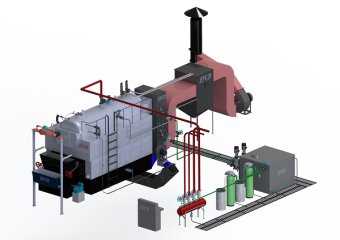
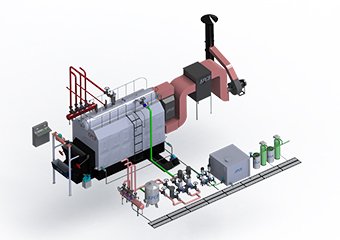
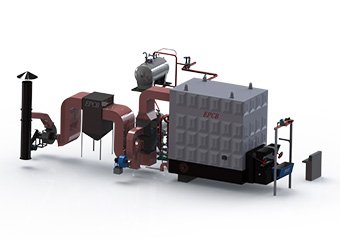
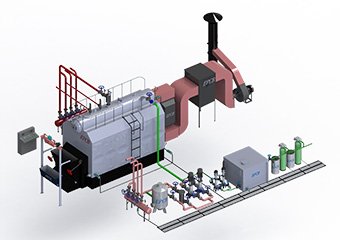
The boiler adopts a mature horizontal single-drum longitudinal chain grate structure with a compact overall layout. The structural design fully considers the requirements of fuel combustion, heating surface arrangement, flue gas flow, and long-term operation and maintenance.
For coal-fired boilers, stable operation depends primarily on whether the combustion organization is reasonable.
EPCB enables coal to complete the preheating, ignition, combustion, and burnout processes sequentially on the chain grate through the rational design of furnace space, grate structure, furnace arch, and air distribution method.
Chain grate furnaces can continuously complete the fuel delivery and combustion process. Compared with manual intermittent coal feeding, they are more conducive to maintaining stable combustion conditions in the furnace and also reduce the labor intensity of operators.
In response to the continuous production characteristics of food enterprises, the boiler heating surfaces have been rationally arranged to ensure that the heat generated by fuel combustion can be more fully transferred to the boiler feedwater.
At the same time, the flue gas flow path is rationally organized so that the high-temperature flue gas passes through the main heating areas in sequence, thereby improving the utilization of flue gas heat and reducing unnecessary heat loss while ensuring stable boiler output.
For clients, these designs ultimately manifest in one most direct result:
When the production line needs steam, the boiler can continuously and stably provide the required steam.
Stable steam pressure and output can reduce the impact of steam supply fluctuations on heating, cooking and other production processes, providing a reliable thermal energy foundation for continuous production in soy sauce factories.
Complete Boiler Auxiliary System Supports Reliable and Efficient Operation
Whether an industrial boiler system is truly efficient cannot be judged solely by the boiler itself.
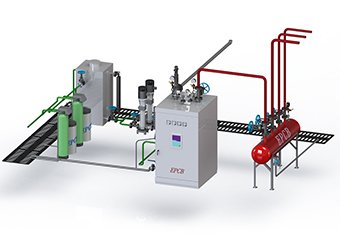
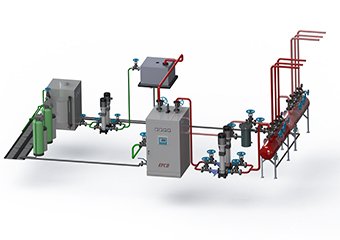
The proper coordination between water treatment, water supply, combustion, flue gas treatment, slag removal, chimney, and control system will also affect the final operating performance of the boiler.
Therefore, in the Thai soy sauce factory project, EPCB not only provided In addition to the boiler body, corresponding auxiliary equipment is also configured according to the overall system operation requirements.
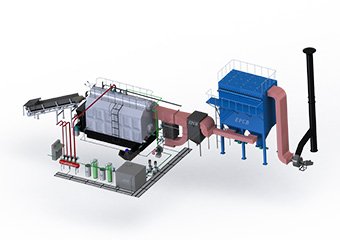
Economizer: Further recovers waste heat from flue gas
The flue gas produced by boiler combustion still contains a certain amount of heat after completing the main heat exchange.
Economizers can utilize this waste heat from the flue gas to preheat the feedwater entering the boiler, allowing the feedwater to acquire some heat energy before entering the boiler.
This reduces the fuel consumption required for the boiler to heat the feedwater to saturation and also reduces the amount of heat carried away during flue gas exhaust.
For industrial boilers that have been operating for a long time, continuous recovery of waste heat from flue gas is of practical significance for improving the energy utilization level of the entire boiler system.
Dust removal equipment: controls dust in the flue gas of coal-fired boilers.
Coal-fired boilers generate a certain amount of smoke and dust during operation, so flue gas purification is an indispensable part of the entire boiler system.
EPCB configures appropriate dust removal equipment according to the project's operational needs to separate and treat dust particles in the flue gas, reducing the direct discharge of dust with the flue gas.
By properly coordinating the boiler combustion system and flue gas treatment equipment, the boiler can better meet the environmental protection requirements of industrial production while satisfying production needs.
Exhaust fan: Maintains reasonable furnace pressure and flue gas flow.
The induced draft fan is an important component of the flue gas system of a coal-fired boiler.
During operation, the induced draft fan guides the flue gas generated by combustion through the boiler heating surface, economizer and dust removal equipment in sequence, and finally discharges it through the chimney.
Appropriate air volume and furnace pressure help maintain a stable combustion process.
By coordinating the supply and exhaust air systems, the fuel can receive adequate combustion air and the flue gas can be kept flowing stably, creating favorable conditions for the continuous operation of the boiler.
Automatic slag removal system: Reduces operation and maintenance workload
Coal combustion produces slag.
The slag removal equipment configured in the project can continuously discharge the slag produced by combustion from the boiler system, reducing the amount of manual slag removal work, and at the same time helping to maintain the normal operation of the grate and furnace area.
For food factories that require continuous production over long periods, a sophisticated slag removal system can help reduce the operational burden caused by slag handling.
Chimneys: Ensuring the smooth emission of flue gas
After heat exchange and dust removal, the flue gas is finally discharged through the chimney.
EPCB makes reasonable matching based on factors such as boiler flue gas volume and system resistance, so that the entire flue gas system forms a stable flue gas exhaust channel, providing a guarantee for the continuous operation of boiler combustion and flue gas treatment system.
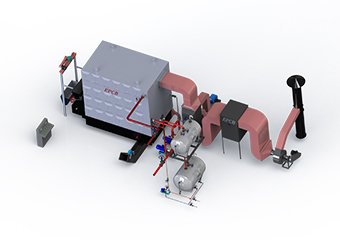
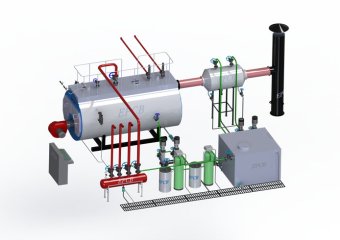
These auxiliary machines are not independent devices from the boiler body, but together they form a complete 6-ton coal-fired steam boiler system .
EPCB Provides Professional On-Site Boiler Installation Support in Thailand
Industrial boilers are not ordinary pieces of equipment that can be put into operation immediately after being delivered to the customer's factory and connected to water, electricity and steam pipelines.
The quality of boiler installation directly affects subsequent operational safety, combustion status, steam supply, and equipment lifespan.
Therefore, during the installation phase of the project in Thailand, EPCB arranged for professionals to go to the customer's factory to provide on-site installation guidance.
Technical personnel provided guidance on the installation of the boiler body, auxiliary equipment, piping connections, and related systems, taking into account the actual site conditions, and assisted customers in inspecting key installation aspects.
Compared to simply providing installation drawings, on-site technical guidance can more promptly identify and resolve problems that arise during project implementation.
The size of boiler rooms, equipment foundations, pipeline routes and actual construction conditions vary from factory to factory. Even if a thorough design has been done in the early stage, there may still be details that need to be adjusted on site.
EPCB engineers worked with the client's construction team to resolve practical problems during the installation process through on-site communication, helping the entire boiler system to be installed smoothly.
At the same time, technicians also provide technical guidance to relevant customer personnel on boiler operation and daily maintenance, enabling operators to have a more comprehensive understanding of the equipment structure, operating logic, and basic maintenance requirements.
This face-to-face technical support further enhances customers' recognition of EPCB's professional capabilities.
Responsive Online Technical Support Ensures Reliable Overseas Boiler Service
One of the biggest challenges of overseas projects is not whether the equipment can be delivered to the customer's factory, but whether the supplier can continue to provide stable technical support after the equipment is put into operation.
EPCB has always considered after-sales service as an important part of boiler projects.
In the Thai soy sauce factory project, one of the key takeaways the client gave from the EPCB team was:
The response was prompt, and the online service was excellent.
When customers encounter technical problems during installation, commissioning, or operation, the EPCB team can promptly understand the on-site situation through online communication and provide targeted technical advice based on equipment operating parameters, photos, videos, and customer feedback.
For issues that can be diagnosed and resolved remotely, the engineering team provides timely operational guidance; for issues requiring further inspection, they help clients outline the inspection steps and key locations.
This online-offline integrated service model ensures that the service does not stop even after the equipment has been delivered or the parties are in different countries.
From on-site installation guidance to post-operation support, and the addition of flow meter systems and APP monitoring, the cooperation between EPCB and its customers has been ongoing.
EPCB Boiler Delivers Long-Term Industrial Steam System Solutions Beyond Boiler Supply
The Thai soy sauce factory project once again demonstrates EPCB's service philosophy in overseas industrial boiler projects:
Boiler delivery is not the end of service, but the beginning of long-term operational support.
For food, textile, chemical, pharmaceutical, feed and other manufacturing companies, the steam demand, fuel conditions, operating pressure, production rhythm and energy management objectives vary from plant to plant.
Therefore, EPCB does not simply recommend the same standard equipment to all customers, but rather aims to help customers analyze issues such as boiler capacity, fuel selection, combustion system, heat recovery, auxiliary equipment configuration, automatic control, and subsequent energy management based on their actual production needs.
From a single boiler to a complete boiler system;
From on-site installation to long-term online technical support;
From stable steam generation to monitoring every point of steam consumption;
EPCB is continuously combining its industrial boiler manufacturing capabilities with its systems engineering, intelligent monitoring, and global service capabilities.
safe, stable, efficient and more intelligent steam boiler system solutions to more global industrial customers with its professional industrial boiler technology, comprehensive project execution capabilities and continuous after-sales service .
For EPCB, a truly successful boiler project is not just about the smooth delivery of the equipment.
Years later, when customers need steam system upgrades, energy-saving optimizations, or technical support again, they are still willing to choose EPCB as a long-term partner.