

In industrial boiler projects, equipment delivery is only the beginning of the collaboration. What truly reflects the quality of the boiler and the professionalism of the supplier is whether the equipment can maintain a stable and safe working condition several years after it has been put into operation, and whether the supplier continues to pay attention to the actual operation of the customer.
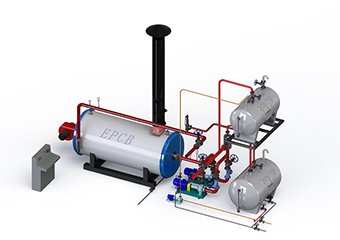
Recently, the EPCB boiler sales and technical team revisited a long-standing client in the Colombian textile industry . This client uses a coal-fired thermal oil boiler system supplied by EPCB. This equipment has been serving the client for approximately 11 years since its initial deployment .
After a long period of operation, the boiler is still in good overall condition and can continue to provide stable heat energy support for the customer's textile production.
For EPCB, this follow-up visit was not just a routine after-sales service, but also a true test of the equipment's long-term performance.
Stable Industrial Heating Solutions for Colombia’s Textile Industry
The textile industry is one of the industries that uses industrial heat energy in a relatively concentrated manner.
Depending on the specific production process, textile companies typically require a continuous and stable supply of heat energy during dyeing, setting, drying, finishing, and other production stages. Especially in processes that demand higher temperatures and require minimal temperature fluctuations, the stability of the heat source system directly impacts production rhythm and process control.
For customers, choosing an industrial boiler involves not only considering the rated power, but also the operational stability, temperature control, combustion performance, operation and maintenance, and long-term service capabilities .
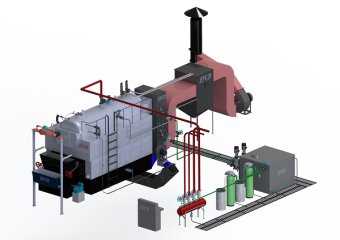
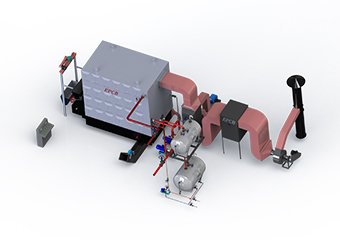
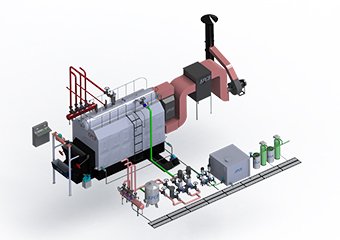
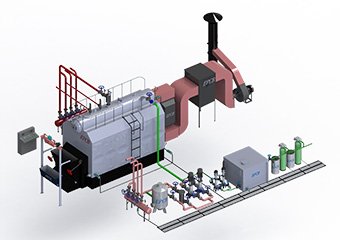
Based on these needs, EPCB thoroughly understood the customer's operating conditions in the early stages of the project and configured a coal-fired thermal oil boiler system suitable for textile production . After 11 years of operation, the system remains in good condition and continues to provide stable heat energy for the customer's production.
Why Thermal Oil Boilers Are Used in Textile Manufacturing
Compared with traditional steam boilers, an important feature of thermal oil boilers is that they can use thermal oil as a heat carrier to provide relatively stable high-temperature heat energy for production equipment.
This heating method is clearly applicable to certain textile processes.
The heat transfer oil system uses a circulating pump to drive high-temperature heat transfer oil to circulate between the boiler and the heat-using equipment, transferring the heat generated by the boiler to the setting machine, drying equipment or other production equipment.
When properly designed and operated, this system can achieve:
Relatively stable process temperature
Some heat treatment processes in textile production require high temperature stability. A heat transfer oil system can continuously supply heat through circulation, helping to maintain a relatively stable production temperature.
Higher operating temperature
For production lines requiring higher process temperatures, heat transfer oil heating can provide suitable thermal conditions.
Central heating
A fully designed heat transfer oil system can provide a heat source for different heat-using equipment according to project requirements.
Facilitates production control
With a well-designed temperature detection, circulation control, and combustion control system, the boiler's operating status can be adjusted according to the actual production load.
Therefore, for customers, the boiler is not a standalone piece of equipment, but an important component of the entire textile production thermal energy system.
EPCB Coal-Fired Thermal Oil Boiler Remains in Reliable Operation After 11 Years
Time is one of the most direct ways to test the reliability of industrial equipment.
This EPCB coal-fired thermal oil boiler has been in operation for about 11 years since it was put into the customer's factory.
From the perspective of boiler equipment, 11 years means that the equipment has experienced a large number of start-ups, shutdowns, heating up, cooling down, load changes, and continuous production.
Especially for coal-fired boilers, the long-term operation of the equipment involves not only simple heat exchange issues, but also:
It involves multiple aspects such as fuel combustion, grate operation, furnace temperature, flue gas flow, heat exchange of heating surfaces, heat transfer oil circulation, and daily maintenance.
If any link is not properly controlled over a long period of time, it may gradually affect the operation of the entire system.
The EPCB team visited the customer's factory again to gain a more realistic understanding of the boiler's actual performance after long-term operation through on-site follow-up.
Judging from the situation on site, this coal-fired thermal oil boiler, which has been in service for 11 years, is still in good overall operating condition and continues to undertake the task of supplying heat energy required for customer production.
For an industrial boiler, such long-term stable operation is itself a strong testament to the effectiveness of equipment design, manufacturing, and daily maintenance by the customer.
Combustion System Design for Long-Term Coal-Fired Boiler Operation
Coal-fired boilers have higher requirements for fuel adaptability, combustion organization, and ash and slag treatment . The particle size, moisture content, and calorific value of coal fluctuate, so reasonable furnace design and air distribution control are particularly important.
Stable combustion helps reduce ash buildup, lower maintenance frequency, and maintain long-term operational efficiency. Therefore, EPCB places greater emphasis on the overall matching of the boiler body, combustion, flue gas, and thermal oil circulation systems , rather than focusing on a single parameter.
Stable Thermal Oil Circulation Supports Reliable Boiler System Operation
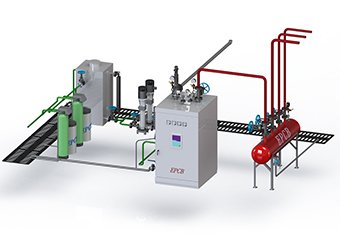
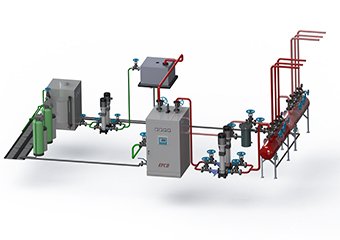
One key difference between thermal oil boilers and steam boilers is that thermal oil systems rely on circulating pumps to continuously drive the heat transfer medium circulation.
The heat generated by the boiler is first transferred to the heat transfer oil, and then the high-temperature heat transfer oil is transported to the production equipment for heat exchange before returning to the boiler for further heating.
Therefore, stable circulation of heat transfer oil is very important.
During the system design process, it is necessary to reasonably consider the circulation flow, pipeline resistance, expansion space, and matching relationships between equipment.
For long-term operation projects, attention should also be paid to the quality of heat transfer oil, the cleanliness of the system, the operating status of the circulating pump, and related instruments.
This customer follow-up also highlighted an important point:
A thermal oil boiler that can operate for a long time is actually the result of the long-term coordinated operation of a complete thermal energy system.
This is also an important reason why EPCB has long insisted on providing boiler system solutions.
11 Years of Operation Demonstrate Long-Term Boiler Manufacturing Quality
Industrial boilers are equipment that operates for extended periods.
Unlike some short-cycle equipment, boiler customers often expect their equipment to last for many years.
Therefore, during the manufacturing stage, materials, welding, processing, assembly, and quality inspection all affect the actual service life of the equipment in the future.
For customers, whether a boiler looks good when they buy it is not the most important thing.
What really matters is the condition of the equipment a few years from now.
The EPCB coal-fired thermal oil boiler used by the Colombian customer has been in operation for 11 years and is still able to continue to undertake production tasks.
These real-world, long-term operational cases are more convincing than simply presenting equipment parameters.
This demonstrates that a well-designed, properly manufactured, and correctly maintained industrial boiler can continuously provide value to a customer's production system.
EPCB Customer Follow-Up Service Supports Long-Term Boiler Operation
Many boiler suppliers gradually reduce their contact with customers after the equipment is sold.
EPCB prefers to establish long-term partnerships.
Therefore, even if the equipment has been in operation for many years, the EPCB team will still visit customers to understand the equipment's usage status and the customer's new production needs.
During this follow-up visit to a long-term Colombian customer, the EPCB team focused on the current operating status of the boiler and communicated with the customer about their actual experience during long-term use.
The significance of this follow-up visit goes beyond just checking the equipment.
More importantly, it's about understanding through real projects:
Which parts of the equipment perform well after long-term use?
What problems did the customer encounter during routine maintenance?
Has the customer's production load changed?
Has there been any change in fuel usage?
Does the factory have any plans to expand production or upgrade equipment in the future?
This information from real production sites will also be continuously fed back into EPCB's subsequent boiler design, manufacturing, and service work.
Professional After-Sales Service Throughout the Boiler Lifecycle
Industrial boiler equipment typically has a long service life.
Therefore, truly valuable after-sales service should not be limited to the initial installation phase of the equipment.
From project confirmation, manufacturing, transportation, and installation guidance, to commissioning, training, and follow-up visits, EPCB aims to provide a relatively complete service process.
For long-term customers, follow-up services can help both parties understand the current status of the equipment.
If customers upgrade their production lines, expand capacity, or change fuels in the future, EPCB can also provide new technical advice based on the new operating conditions.
This ongoing service approach ensures that customers are not just buying a one-time boiler, but are receiving ongoing professional support throughout the long term of operation.
11 Years of Customer Trust Reflect Long-Term Boiler Reliability
In the industrial equipment sector, the most important brand trust often comes not from advertising, but from long-term operational results.
A customer purchasing a boiler constitutes a collaboration.
If a customer still approves of a boiler after it has been running continuously for many years, it represents a deeper level of trust.
The coal-fired thermal oil boiler used by the Colombian textile industry customer has been in operation for 11 years and the equipment is still performing well.
This is a very meaningful case study of an old customer for EPCB.
This demonstrates that EPCB's focus is not simply on completing equipment sales, but on ensuring that boilers truly integrate into customers' production systems and create long-term value.
EPCB Provides Ongoing Support for Long-Term Boiler Operation
A single equipment delivery can complete a project, but only long-term stable operation can truly fulfill the customer's expectations for industrial boilers.
From the time the equipment went into production 11 years ago until today, when the EPCB team returned to the customer's factory, this coal-fired thermal oil boiler continues to play a role in the textile production line.
For EPCB, this not only demonstrates the long-term reliability of the equipment, but also reiterates:
The true value of an industrial boiler lies not only in its ability to operate immediately after installation , but also in its ability to reliably serve customers' production for many years to come.
In the future, EPCB will continue to focus on the real production needs of its customers, providing more reliable boiler system solutions for global industrial customers, from boiler selection, system design, manufacturing, installation and commissioning to long-term after-sales service.
For long-term clients with whom EPCB has maintained cooperation, EPCB will continue to stay in touch to understand the equipment's operating status and the company's future new energy needs.
Eleven years of stable operation is not the end of the cooperation, but rather the beginning of another kind of long-term trust.