

In the basic chemical industry, a stable, continuous, and controllable supply of heat energy is a crucial foundation for ensuring production quality and pace. Especially in coating, resin, adhesive, and other production processes requiring indirect heating, companies not only focus on whether equipment can provide sufficient heat, but also place greater emphasis on temperature control, system stability, operational safety, and long-term maintenance costs.
Some time ago, the EPCB boiler engineering team revisited a long-term customer's factory .
This is a company engaged in the production of basic chemical products, primarily used in glove coating . To meet the continuous and stable process heating requirements during production, the customer previously selected a thermal oil boiler system provided by EPCB .
This follow-up visit was not a simple equipment inspection.
For EPCB, the delivery of a boiler system does not mean the end of the project service. By regularly visiting the customer's production site to understand the actual operation of the boiler, changes in production conditions, and the customer's subsequent needs, EPCB can further optimize its services and provide continuous technical support for the customer's long-term stable production.
Glove Coating Production Requires Stable and Precise Process Heating
While glove manufacturing may seem to fall under the category of light industrial production, the production process involved in glove coating has high requirements for temperature control and heating stability.
In some glove production processes, it is necessary to heat the coating materials, chemical raw materials, or related production media to maintain a suitable processing temperature. If the heating temperature fluctuates significantly, it may not only affect the production schedule but also further impact the coating condition, material properties, and the consistency of the final product.
a stable, continuous and controllable heat output at a suitable operating temperature .
This is also one of the important reasons why customers choose thermal oil boilers.
Unlike some production processes that rely on steam for heating, heat transfer oil systems use a heat transfer medium to transfer heat in a circulating system, which can achieve higher process temperatures at relatively low system pressures.
For processes requiring stable indirect heating, such as chemical, coating, resin, oil, printing and dyeing, and reaction kettle processes, industrial thermal oil boilers typically have good application adaptability.
After communicating with EPCB in the early stages of the project, the client ultimately chose EPCB's thermal oil boiler solution for the heat supply during the glove coating production process, based on their own production process, heating method and site conditions.
EPCB Provides More Than a Thermal Oil Boiler
For industrial boiler projects, what truly affects long-term operational performance is not just the boiler itself.
The design of the combustion system, circulation system, control system, pipeline, on-site installation, and commissioning methods can all directly affect the stability of the entire heating system in its later operation.
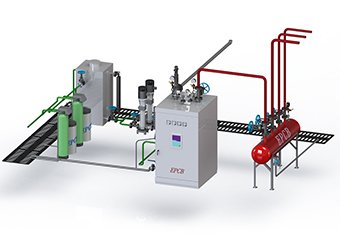
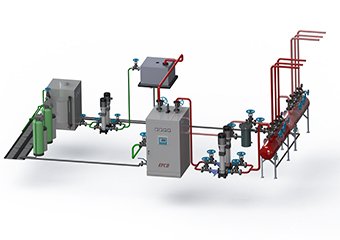
Therefore, during project implementation, EPCB does not simply provide customers with a thermal oil boiler, but rather takes a holistic approach from the perspective of the entire industrial heating system , providing systematic solutions based on the customer's actual production needs.
At the beginning of the project, the EPCB technical team will combine the customer's production process to understand the actual heat demand, including process temperature, production load, running time, fuel conditions and on-site installation space.
Based on this, the boiler and related systems will then be configured.
This approach can minimize the problem of unreasonable equipment configuration caused by simply selecting equipment based on maximum load, and it is also conducive to the long-term stable operation of the system.
For EPCB, boiler selection is not simply about determining a specific equipment model, but rather about considering the operational issues that customers may encounter in their actual production over the next few years.
Double-Coil Structure Improves the Heating Surface Arrangement
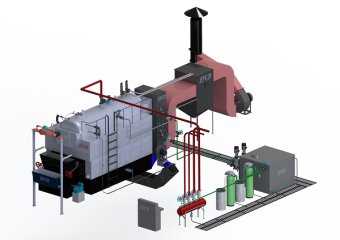
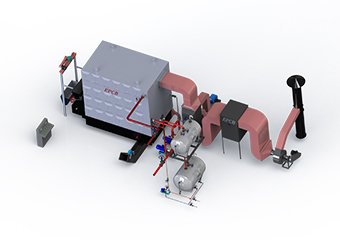
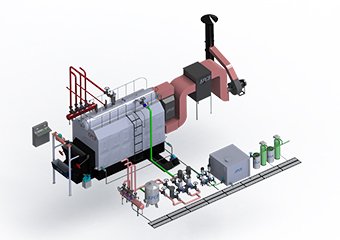
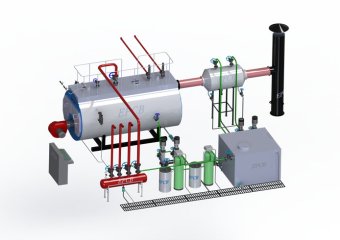
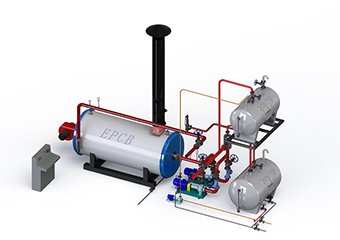
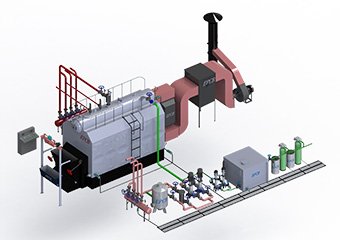
The EPCB thermal oil boiler used in this project adopts a double-coil structure .
The core working process of a thermal oil boiler is to heat the thermal oil circulating inside the coil with the high-temperature flue gas generated by combustion, and then the thermal oil will transfer the heat to the production equipment.
Therefore, the coil structure and the heat exchange method between flue gas and the heating surface directly affect the overall operating performance of the boiler.
The dual-coil structure allows for the rational arrangement of heating surfaces within a limited boiler space, enabling full heat exchange between the high-temperature flue gas and the coils.
For industrial production, a reasonable design of the heating surface is not only related to the boiler's heat output, but also affects the flue gas temperature, fuel utilization rate, and overall equipment size.
During the boiler structure design process, EPCB comprehensively considers factors such as heat load, flue gas flow, and heat transfer oil circulation to ensure that the boiler maintains stable operation while meeting production heating requirements.
For applications like glove coating production that require continuous heating, stable heat output is particularly important.
Three-Pass Flue Gas Design Improves Heat Utilization
In addition to the dual-coil structure, this thermal oil boiler adopts a three-pass flue gas design.
The high-temperature flue gas generated after fuel combustion is not directly discharged, but passes through multiple heat exchange zones inside the boiler according to the designed flue gas flow, so that the heat in the flue gas can be further utilized.
By reasonably extending the heat exchange process between the flue gas and the heating surface, the utilization rate of the heat generated by the fuel can be improved.
For industrial enterprises that operate continuously for a long period of time, boiler operating costs are not determined by the one-time purchase price.
Fuel consumption, operating hours, maintenance costs, and equipment lifespan all affect the lifecycle cost of the entire project.
Therefore, when designing boilers, EPCB pays more attention to the long-term operating status of the equipment, rather than just the technical parameters when the equipment leaves the factory.
The combination of a reasonable three-pass flue gas design and coil structure is conducive to achieving a more efficient heat exchange effect in a compact boiler structure, while meeting the requirements of industrial users for space utilization and operating efficiency.
Compact Boiler Design Adapts to Industrial Plant Conditions
Chemical companies often face a very real problem when adding or replacing boiler systems— limited on-site installation space .
The factory premises often already have production equipment, raw material areas, pipelines and other utility systems, so the installation of boilers and auxiliary equipment cannot be divorced from the actual site conditions.
This EPCB thermal oil boiler features a compact design that optimizes the overall equipment layout while meeting the requirements for heating surface and combustion space.
Compact design can help companies make more rational use of boiler room space and reduce the complexity of on-site installation and system layout.
However, EPCB believes that "compact" does not mean simply reducing the size of the device.
A truly rational boiler design requires a balance between equipment size, heating surface, flue gas passage, maintenance space, and ease of operation.
Only by fully considering these factors can the boiler be more convenient to operate, inspect, and maintain after it is put into use.
EPCB Engineers Provide On-Site Installation and Commissioning Support
on-site installation and commissioning are equally important for the long-term stable operation of industrial boiler projects .
Problems in any of the following areas—pipeline connections, circulation system layout, valve installation, instrument setup, and system commissioning—can affect subsequent operational performance.
Therefore, during the implementation of this project, EPCB not only provided the equipment, but also provided on-site installation guidance and commissioning support to the customer.
EPCB engineers assist customers with system installation based on the actual project situation and check the connection and operating conditions of key equipment.
After the boiler is installed, engineers will also conduct adjustments based on the system's operation to gradually bring the combustion, circulation, and control systems to a suitable operating state for the customer's production.
At the same time, EPCB will also explain the basic operating logic of the equipment, daily inspection items, and maintenance precautions to the customer's on-site operators.
For EPCB, an industrial boiler is only considered truly completed when it is operating stably on the customer's production line and continuously meets the actual process requirements.
Long-Term Cooperation Is Built on Reliable Equipment and Professional Service
For industrial enterprises, choosing a boiler supplier is essentially choosing a long-term partner.
Boilers typically need to operate for many years.
During this period, customers may experience changes in raw materials, energy prices, production line expansion, and adjustments to production processes.
Therefore, a professional boiler supplier not only needs to provide reliable equipment, but should also be able to provide continuous technical support to customers.
This follow-up visit to long-term customers in the basic chemical industry perfectly embodies EPCB's consistent service philosophy.
From initial needs communication to boiler selection, system design, manufacturing, installation guidance, operation and commissioning, and long-term follow-up visits after the equipment is put into use, EPCB aims to participate in the entire lifecycle of the customer's boiler system.
This partnership does not end after the boiler is delivered, but continues to extend after the equipment is actually put into production.
From Boiler Manufacturing to Complete Heating System Solutions
EPCB has always believed that what industrial customers really need is not "a boiler", but a complete thermal energy solution that can meet their production needs in the long term .
In this glove coating manufacturing project, the EPCB thermal oil boiler provides a stable process heat source for the production process through its dual-coil structure, three-pass flue gas design, and compact equipment layout .
Beyond the equipment, the system design, on-site installation guidance, commissioning, and follow-up services provided by EPCB are also important components of the project.
A single equipment purchase may only take a few months, but an industrial boiler often needs to serve the customer for many years.
Therefore, EPCB is more concerned with the long-term operation of equipment after delivery.
By repeatedly visiting customers' factories to understand the actual production situation, solve practical operational problems, and provide new technical suggestions based on customers' future development, EPCB hopes to establish not just an equipment supply relationship with customers, but a long-term and stable cooperative relationship.
For companies in basic chemicals, coatings, resins, food, textiles, and other industries that require industrial heating, a truly professional boiler partner needs to understand both the equipment and the production process.
This is also the direction that EPCB has consistently adhered to.
EPCB — Your Personal Boiler System Expert.
From boiler selection to complete system design;
from equipment manufacturing to installation and commissioning;
from project delivery to long-term follow-up services.
EPCB is always based on the actual production needs of its customers, providing global industrial enterprises with more reliable, professional and comprehensive boiler system solutions.