Reasons for High Exhaust Gas Temperature in Boilers and How to Fix Them

November 13, 2026

High exhaust gas temperature in boilers means the flue gas leaves hotter than the boiler’s clean, tuned baseline at similar load and fuel. That extra heat is fuel that never reached the water. The US Department of Energy puts the cost at about 1% of boiler efficiency for every 40°F of extra stack temperature. The usual causes are soot or ash on the fireside, scale on the waterside, too much excess air, air leaking in, and an economizer or baffle that no longer does its job. High load and a fuel change raise the reading too. Oxygen, gas-side pressure drop and, where fitted, economizer temperatures narrow the likely causes.


How Much High Exhaust Gas Temperature Costs in Efficiency

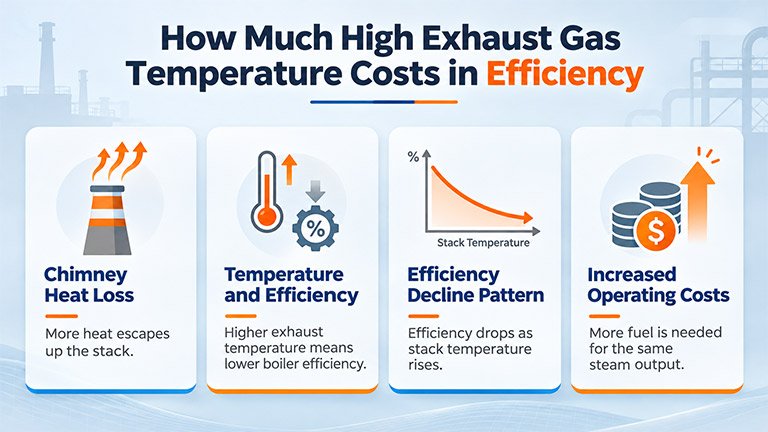
High exhaust gas temperature raises the largest single heat loss of a boiler, the heat carried out of the stack. Generally, this loss is about 6% of the heat input to the furnace. In the DOE’s combustion efficiency table for natural gas, a 400°F net stack temperature with 3% oxygen gives 80.4% combustion efficiency.


The penalty grows with temperature. The heat loss of exhaust gas rises by about 0.5% for every 12–15°C (22–27°F) increase. The DOE rule of thumb is close to that: 1% efficiency per 40°F. Our steam cost guide shows how that loss feeds into cost per ton of steam. Our analysis of boiler economy covers the wider economics of exhaust loss.


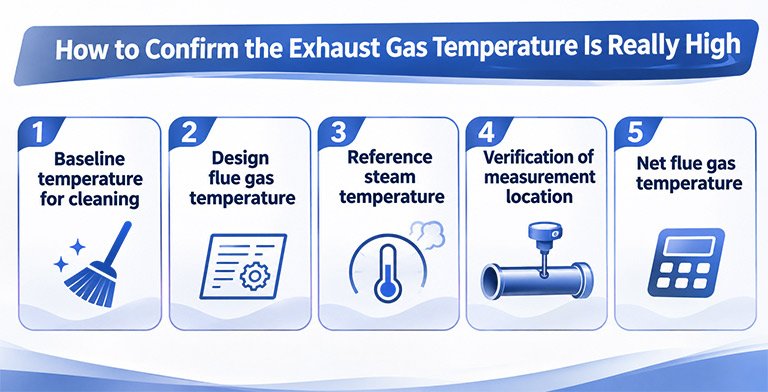
How to Confirm the Exhaust Gas Temperature Is Really High

A high stack temperature is a reading above the boiler’s expected range for its operating conditions. Compare it with a clean, tuned baseline at similar load and fuel, and note any change in oxygen or feedwater temperature. The DOE’s scale tip sheet sets the same firing rate and oxygen level as the condition for trending stack temperature.


Use three references before looking for a fault:


1. Clean baseline. Record stack temperature, oxygen, load and draft loss after each cleaning or tune-up. Compare later readings only at the same load and oxygen.


2. Design value. Take the design exhaust temperature from the boiler data sheet. If the reading shows a sustained rise above the clean baseline, verify the sensor and review oxygen, feedwater temperature and gas-side pressure drop.


3. Steam temperature. The DOE’s economizer tip sheet notes that flue gas is often sent to the stack more than 100–150°F above the steam temperature. At 150 psig, saturated steam is about 366°F; judge the stack reading against the clean baseline and design data.


Check the instrument first. A thermocouple in a dead pocket of the duct reads wrong, and so does one downstream of an air leak. Place it at the boiler or economizer outlet, before any dilution air. Then record combustion air temperature and log the net stack temperature, which is stack temperature minus combustion air temperature.


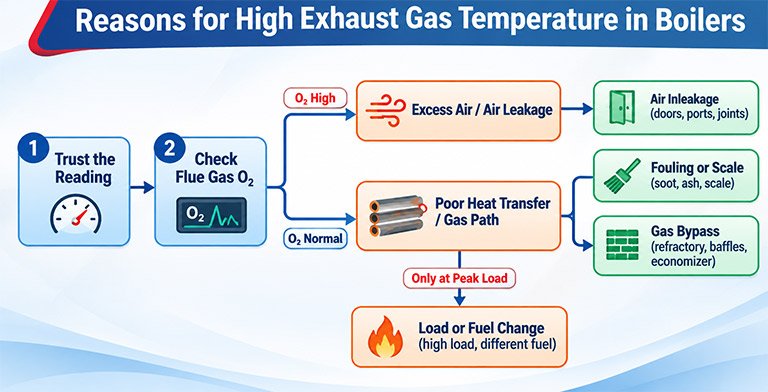
Reasons for High Exhaust Gas Temperature in Boilers

A steady rise in stack temperature with a growing gas-side pressure drop points toward fouling, while a sudden step change calls for a check of bypasses and seals.


Slagging or Ash Deposits on the Heating Surfaces


Slag or ash on the heating surfaces is a common cause of a slow, steady rise in exhaust temperature. The deposit can sit on the furnace water walls, the superheater, the convection tube bundles, the economizer or the air preheater. It adds thermal resistance, so the flue gas cools less before it leaves.


• Check: The temperature climbs over weeks while oxygen stays normal. Gas-side pressure drop (draft loss) across the boiler or economizer rises as deposits narrow the gas path. Firing coal, biomass or heavy oil makes this cause more likely.


• Fix: Clean the fireside, and set soot-blowing frequency from the fouling trend and the equipment’s operating procedure. Then record a new clean baseline. Rapid fouling after cleaning points back to combustion, covered under fuel type and tuning below.


Scale on the Waterside


Scale on the waterside raises exhaust temperature in the same way as soot, but the deposit is inside the tubes or shell. For fire-tube boilers without an economizer or air preheater, the DOE lists estimated fuel losses by scale thickness. A 1/32-inch layer of normal scale costs about 2.0% of fuel. Iron plus silica scale of the same thickness costs about 7.0%.


• Check: Stack temperature rises while the fireside looks clean. Inspect the waterside at the next shutdown and review feedwater hardness and blowdown records against the plant’s boiler water treatment program.


• Fix: Remove the scale by approved mechanical or chemical cleaning, then stop it at the source. Pretreat makeup water with Boiler Water Treatment Equipment suited to the boiler’s water chemistry, control chemical dosing and keep the specified boiler blowdown.


Excess Air Coefficient Too High


An excess air coefficient that is too high adds stack loss and, in many boilers, raises exhaust gas temperature. At the same firing rate, more air means more flue gas mass and a lower furnace temperature. The gas also moves faster and spends less time over each heating surface. Compare oxygen and outlet temperature with the clean baseline to see the effect on that boiler.


• Check: Flue gas oxygen is above the burner setting at the same load. In the DOE table at a 400°F net stack temperature, 7% oxygen gives 78.2% combustion efficiency and 3% oxygen gives 80.4%. The DOE notes that well-designed gas systems can reach about 10% excess air.


• Fix: Retune the air-to-fuel ratio across the firing range, and check linkages and dampers for slip. An oxygen trim system holds the setting as load and air temperature change.


Air Leakage into the Furnace and Flue


Air leaking into the furnace or flue acts like extra excess air and raises oxygen measured downstream. Some leakage is unavoidable in negative-pressure and balanced-draft boilers, and boiler thermal design assigns an allowable leakage coefficient to each heating surface. Air leaking in near the furnace passes every heating surface and raises the exit temperature. Air leaking in after the heat transfer surfaces adds flow but can cool the mixed gas, so the stack reading may even fall.


• Check: Oxygen rises between the furnace outlet and the economizer or stack sampling point. Look for leaks at furnace roof seals, sight ports, manhole doors, expansion joints and duct flanges. Leakage before an oxygen probe makes the burner appear to have more combustion air than it has.


• Fix: Reseal doors and ports, replace damaged gaskets and expansion joints, and repair cracked casing or ductwork. Pressurized package boilers leak flue gas outward instead, so a casing leak there is a safety issue first.


Feedwater Temperature and Economizer Heat Absorption


Feedwater that enters the economizer hotter raises the exhaust gas temperature. The temperature difference between flue gas and water shrinks, so the economizer absorbs less heat at the same fuel rate. Lower feedwater temperature has the opposite effect. In power plants, a low turbine load or a high-pressure heater out of service lowers feedwater temperature, which lowers exhaust temperature but raises fuel use.


• Check: Log feedwater temperature at the economizer inlet together with stack temperature. A higher stack reading that follows a deaerator pressure change is a process change, not a fault.


• Fix: Keep feedwater within the boiler’s specified range. A lower inlet temperature changes heat recovery and can bring cold metal surfaces below the flue gas dew point.


Economizer, Air Preheater or Baffles Not Working


An economizer, air preheater or baffle that stops working lets hot gas reach the stack with less heat removed. In fire-tube boilers, a cracked rear-door refractory or a failed turnaround seal lets gas skip a pass. Missing turbulators have a similar effect. In economizers, an open bypass damper or fouled fins cut heat recovery.


• Check: Measure gas and water temperatures across the economizer and compare the drop with its design value. A sudden step change in stack temperature at normal oxygen points to a bypass or a refractory failure. A slow drift points to fouling.


• Fix: Repair the refractory or seal, refit baffles and turbulators, and clean or repair the economizer. Where the boiler never had enough heat transfer surface, a Boiler Economizer can recover the stack heat. For conventional economizers, the DOE lists 250°F for natural gas, 300°F for coal or low-sulfur oil, and 350°F for high-sulfur oil as stack temperatures that limit corrosion. Check the fuel dew point and cold-end surface temperatures for the installed system.


Moisture in the Fuel


Moisture in the fuel can raise the exhaust gas temperature because the water turns to vapor and adds flue gas volume. The furnace also runs cooler, so radiant surfaces absorb less heat and more reaches the back passes. The outlet temperature does not rise in every boiler, so compare fuel moisture, load and stack trends together.


• Check: Compare fuel moisture results with the design fuel, especially for biomass, wood chips and coal stored outdoors. Stack temperature and fuel use rise together after wet deliveries.


• Fix: Cover fuel storage, rotate stock, and dry fuel where the process allows.


Boiler Load Above Design


Boiler load above the design rating raises the exhaust gas temperature. Flue gas, steam output, feedwater and air all increase. The furnace outlet temperature rises faster than the convective surfaces can absorb. A boiler with more convective heating surface shows a smaller change in exhaust temperature with load.


• Check: Plot stack temperature against steam flow. If the reading is high only at peak load, compare it with the clean baseline at the same steam flow to separate normal operation, fouling and overload.


• Fix: Spread peaks across boilers, or add capacity.


Fuel Type Changes and Combustion Tuning


A change of fuel or poor combustion tuning can raise exhaust gas temperature with no change in the boiler itself. Low-calorific-value gas with a high share of nitrogen, carbon dioxide or water vapor adds flue gas volume. In that case furnace temperature and radiant heat transfer usually fall. Oil firing leaves less coarse ash than coal, so less ash scours the convection surfaces. Poor atomization then leaves soot, which shows as black smoke and a rising stack temperature.


• Check: Look for black smoke, high carbon monoxide or a sudden fuel change. Compare the new fuel’s composition and burner settings with the design. If back-pass temperature rises rapidly at steady load, suspect afterburning in the flue or air preheater and follow the plant’s emergency procedure.


• Fix: Retune the burner for the new fuel, and clean or replace nozzles. The US rule for area-source boilers burning coal, oil or biomass, 40 CFR 63.11223, sets the tune-up steps. They are to inspect the burner, flame pattern and air-to-fuel controls, and to measure CO and oxygen before and after adjustment.


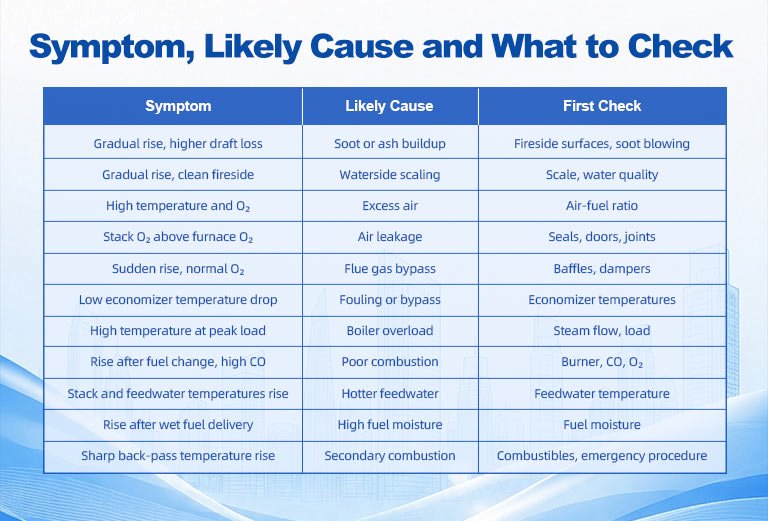
Symptom, Likely Cause and What to Check

High exhaust temperature symptoms map to a likely cause and a first check, including the normal process changes that raise the reading.


Symptom

Likely cause

What to check first

Slow rise over weeks, oxygen normal, draft loss rising

Soot, ash or slag on fireside surfaces

Fireside inspection; soot blower record

Slow rise, fireside clean

Scale on the waterside

Waterside inspection; hardness and blowdown logs

High stack temperature and high oxygen at the burner

Excess air too high

Air-to-fuel ratio across the firing range

Oxygen higher at the stack than at the furnace outlet

Air leakage

Seals, sight ports, doors, expansion joints

Sudden step rise, oxygen normal

Gas bypass: refractory, baffle, damper

Rear door, turbulators, economizer bypass damper

Small economizer temperature drop

Fouled or bypassed economizer

Gas and water temperatures across the economizer

High only at peak steam flow

Load above design

Stack temperature against steam flow

Rise after a fuel change, black smoke or high CO

Fuel type or poor atomization

Burner tune-up, nozzles, CO and oxygen

Feedwater and stack temperatures rise together

Feedwater temperature change

Economizer inlet temperature and deaerator trend

Rise after a wet-fuel delivery

Fuel moisture change

Moisture test against the design fuel

Fast, sharp rise in back-pass temperature

Secondary combustion in the flue

Combustibles in the gas; plant emergency procedure

Where to Start When the Stack Runs Hot


To fix high exhaust gas temperature in boilers, start with the reading, then oxygen, then heat transfer surfaces. Confirm the thermocouple and compare against the clean baseline at the same load. If stack oxygen is high, check for air leaks by comparing upstream and downstream readings before adjusting the burner, and watch carbon monoxide during tuning. If oxygen is normal, inspect the fireside, the waterside and the gas path. For parts, send EPCB the boiler model, fuel, load, oxygen and stack temperature readings. Burners, economizers and other components appear under Boiler Auxiliaries & Parts.


FAQ

What is a normal exhaust gas temperature for a boiler?


A normal exhaust gas temperature for a boiler is the design value on its data sheet, confirmed by a clean, tuned baseline at the same load. The DOE notes that boilers without heat recovery often send flue gas to the stack more than 100–150°F above the steam temperature. With an economizer, the DOE guidance is 250°F for natural gas and 300°F for coal or low-sulfur oil.


Can boiler exhaust gas temperature be too low?


Boiler exhaust gas temperature can be too low. Water vapor or acids condense when a metal surface falls below the relevant dew point, and the corrosion depends on the condensate and the materials it reaches. Cold-end surfaces can be cooler than the measured gas. Condensing boilers are the exception, because their makers build them from materials suited to that condensate.


Is high exhaust temperature in a boiler the same as in a diesel engine?


High exhaust temperature in a diesel engine needs a separate diagnosis, because its causes sit in the engine, not in a boiler. This guide covers fuel-fired boilers.


How often should a boiler burner be tuned?


For affected US area-source boilers subject to 40 CFR 63.11223, biennial tune-ups are no more than 25 months apart. Qualifying oxygen-trim, seasonal, limited-use and oil-fired units rated at 5 MMBtu/h or less follow a 5-year schedule, with no more than 61 months between tune-ups. Gas-fired units fall outside this rule. Check burner settings and combustion readings after a fuel change or burner repair.


  • Send You Inquiry

  • Give You Boiler Solution

  • Place The Order

  • Get Your Boiler

Ask for Boiler Solution Suited Your Condition!

Tell us your need about boiler capacity in your industry, we will recommend the most suitable boiler model for you!

Consult online customer service
Product:
Boiler fuel: