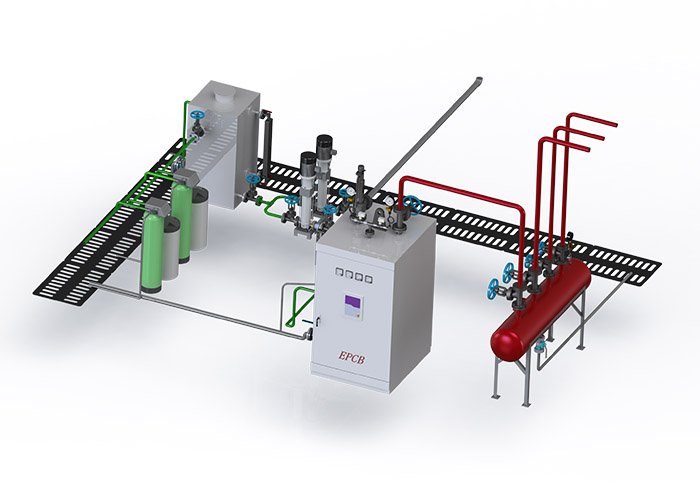
EPCB Boiler is a professional boiler manufacturer in China. Focus on industrial boiler production and sales for 68 years. Our main products are coal-fired boilers, oil gas boilers, biomass boilers, electric boilers, and power plant boilers.

Industrial heating projects often require choosing between a steam boiler and a thermal oil heater. The right choice depends on the temperature needed, the system's pressure limits, and how performance will be verified.
At EPCB Boiler, we design and make industrial steam boilers. We help engineering and procurement teams clarify these variables early to compare options effectively. A choice that overlooks distribution behavior and verification needs can create avoidable operating risks.
Choosing between a steam boiler and a thermal oil boiler depends on process temperature needs, pressure limits, and the site's ability to confirm stable heat delivery. Steam systems generate steam from water, which condenses at the point of use to deliver heat. This process involves managing condensate return and water quality. Thermal oil systems circulate a special fluid in a closed loop, which returns to the heater for reheating.
A reliable plan considers the entire system, from the process boundary to the heat user, not just the heater outlet. If a process needs direct steam contact, moisture, or sterilization, steam is often the answer, depending on temperature and pressure ratings. If a process needs indirect heat at high temperatures, thermal oil is often a good choice, depending on the fluid used, loop integrity, and leak prevention.
At EPCB Boiler, we clarify the scope by confirming temperature targets at the heat user, pressure boundaries across the system, and the documents needed for commissioning. We ensure both options are compared using the same acceptance method so the project team doesn't switch criteria later.
![]()
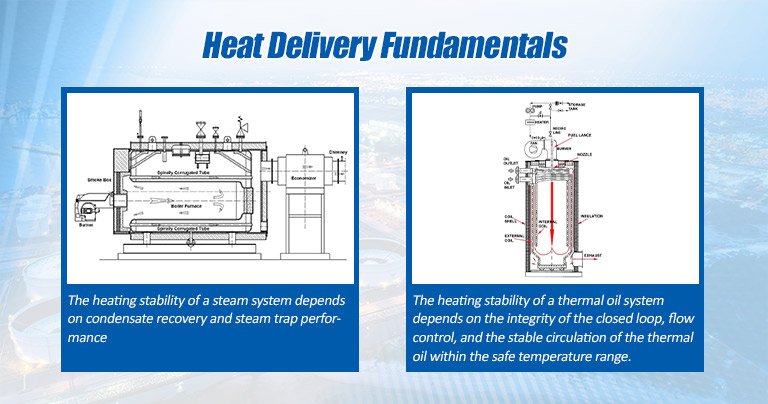
How steam and thermal oil systems deliver heat depends on different factors. For steam, it's about how well condensate returns. For thermal oil, it's about maintaining the integrity of the closed loop and how temperature is checked at the heat user. Steam transfers heat mainly through condensation on surfaces. Therefore, heat delivery stability relies on proper condensate removal and trap performance. Thermal oil transfers heat as a circulating liquid, so its stability depends on flow control, user equipment design, and the fluid's safe operating limits.
Steam distribution usually includes a header network, control valves, traps, and pipes for condensate return and makeup water. Steam projects succeed when condensate returns reliably and water conditions stay within an agreed range. We check distribution boundaries early because steam performance at the user depends on the entire loop, not just the boiler.
Thermal oil distribution includes a circulation pump, an expansion and venting system, and supply and return piping. These projects work well when the loop stays tight, air entry is controlled, and the heat-user design prevents unstable temperatures. We review the loop design based on the plant's measurement points, as closed-loop performance is verified by temperature and flow readings.
![]()
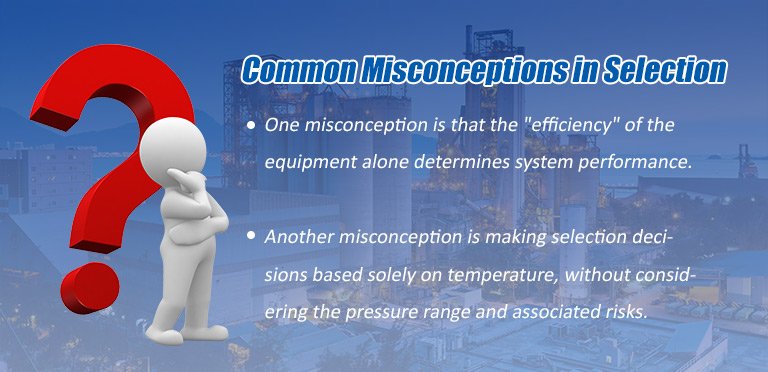
Shortcuts in choosing between a steam boiler and a thermal oil boiler often fail in industrial heating. A better choice relies on measurable variables and verifiable outcomes. A common mistake is using a single metric to make the decision, only to find that distribution losses, maintenance, or verification scope determine the real result. We correct these shortcuts early to keep the comparison focused on what the plant will prove during commissioning.
One misconception is that equipment "efficiency" alone determines system performance. True performance depends on end-to-end losses and controls. For steam, this includes blowdown and condensate handling. For thermal oil, it includes loop integrity and insulation. We compare systems by asking how each option maintains a stable temperature at the heat user under the plant's specific load and inspection routine.
Another misconception is that temperature alone decides the choice, without checking pressure scope and risks. Steam temperature and pressure are linked. Higher temperatures can require a higher pressure rating for pipes and equipment. Thermal oil can provide high temperatures at lower pressure, but it introduces fire and leak risks. These risks must be checked against the layout and insulation choices.
We confirm our decision criteria by tying each claim to a verifiable outcome, such as stable temperature at the heat user, documented condensate return checks, or confirmed loop tightness. A project that cannot verify its chosen criteria often struggles to maintain performance over time.
![]()
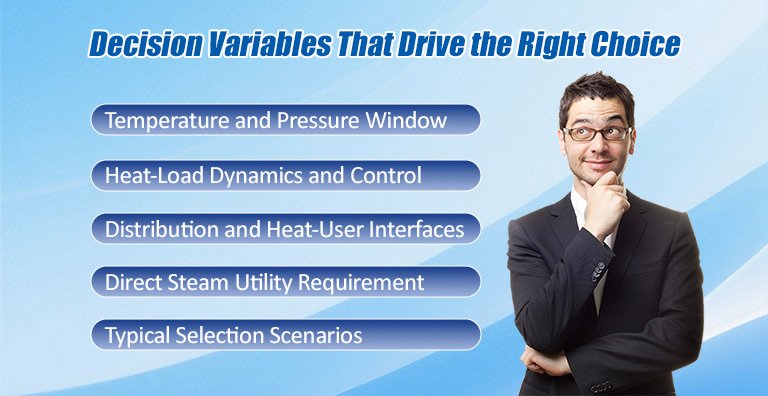
The choice between a steam boiler and a thermal oil boiler becomes more reliable when based on a few key variables. The final decision depends on the temperature target, pressure tolerance, and load stability at the heat user. Projects that skip this step often get lost in pros-and-cons lists that don't lead to a clear decision. We use variables that the plant can measure, document, and verify.
Key decision variables to confirm before comparing options include:
· Target temperature and pressure class: Define the target temperature at key heat users and the pressure class for distribution, as this affects equipment and piping.
· Heat-load dynamics: Define how the heat load changes, as batch swings and ramp rates affect control stability.
· Heat-user interfaces: Define the equipment interfaces, as steam condensation and thermal oil film temperature risks differ by design.
· Distribution distance: Define the piping distance and insulation, as long runs increase losses and inspection scope.
· Acceptance method: Define how performance will be proven, as this drives instrument selection and operating routines.
Temperature and pressure are major drivers in steam vs. thermal oil decisions. Steam systems often need higher pressure as temperature demand rises, which can affect valves, piping, and user equipment. Thermal oil systems can offer high temperatures at lower pressure, but this depends on the fluid's limits, heater design, and safe operating practices.
A plant should verify pressure scope across the entire system, not just at the heater outlet. This includes headers, control stations, and any equipment that could see pressure during normal or upset conditions. We clarify pressure boundaries early to prevent late-stage surprises.
Heat-load dynamics affect control stability and risk. The best system depends on whether the process runs steady, in batches, or with rapid swings. Steam control can provide stable heat if condensate removal is consistent. Thermal oil control can deliver stable temperatures if circulation flow is steady and heat exchangers are designed properly.
The load profile should be confirmed with production data. Ramp rates and allowable temperature drift should be defined as acceptance items. We align the control strategy to the verified load profile so systems are compared under real operating conditions.
Distribution layout and heat-user interfaces affect both losses and verification work. The best fit depends on piping complexity, inspection access, and heat-user design. Steam distribution needs condensate management, and longer runs increase potential loss points. Thermal oil distribution avoids this, but longer runs increase leak detection scope and the importance of proper expansion design.
Heat-user design must also match the chosen medium. Steam exchangers rely on good condensate drainage. Thermal oil exchangers depend on flow rate and safe operating limits, which should be checked during engineering review.
A need for direct steam is a firm constraint. The decision depends on whether the process requires steam contact or just heat. Thermal oil is an indirect medium and cannot supply direct steam injection or humidification. A plant should clarify if a "steam requirement" means direct contact or simply a need for heat.
Some plants have mixed needs. A plant can use steam for direct-use points and thermal oil for indirect high-temperature duty. We clarify how to split these boundaries early in the process.
Typical scenarios can shorten decision cycles. Steam often fits plants that need steam as a utility and can manage water treatment and condensate return. Thermal oil often fits plants that need indirect high-temperature heat and can ensure loop integrity and leak prevention.
Scenario selection should be verified by matching it to measurable acceptance items. Factors like heat-user temperature stability and maintenance capacity should be recorded. We align scenario discussions to verified inputs so the project team can defend its choice.
![]()
Acceptance planning depends on defined measurement points, test procedures, and required documents. A plant that delays this planning may face missing instruments or unclear sign-off criteria during commissioning. We verify the acceptance scope early so the chosen system can be commissioned and maintained properly.
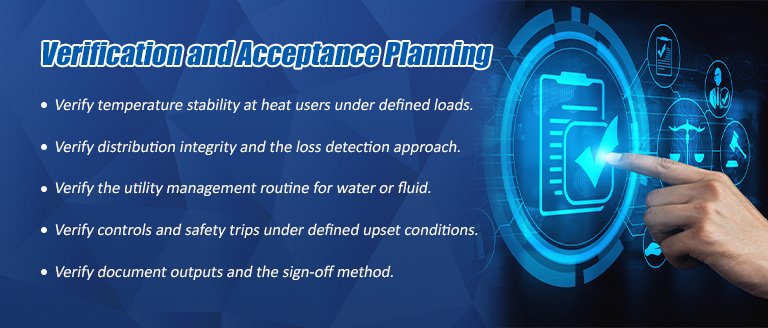
A practical acceptance sequence includes:
· Verify temperature stability at heat users under defined loads.
· Verify distribution integrity and the loss detection approach.
· Verify the utility management routine for water or fluid.
· Verify controls and safety trips under defined upset conditions.
· Verify document outputs and the sign-off method.
Acceptance planning should state what to measure, where to measure it, and how to record the evidence. We clarify sign-off ownership and record format early so acceptance doesn't rely on informal checks.
Steam-side verification focuses on water management and condensate return. The operating burden depends on makeup water condition and the return rate. Water-side control includes treatment, testing, and blowdown management to prevent scaling and corrosion. Condensate return performance affects heat losses and stability at users and should be monitored clearly.
Distribution verification should include trap inspection plans. Poor trap performance can create hidden losses and unstable heat. We verify that the plant has the routine and access needed to keep steam distribution stable.
Thermal-oil verification focuses on fluid condition and loop tightness. Safe operation depends on preventing overheating and limiting air ingress. The fluid must be suitable for the target temperature. The expansion and venting design should be checked to control air entry, as oxygen can degrade the fluid.
Leak prevention should be an acceptance boundary, not just a maintenance task. Thermal oil is flammable, so leakage exposure depends on piping, insulation, and detection plans. We align verification actions with the site's inspection capability to keep the loop stable.
![]()
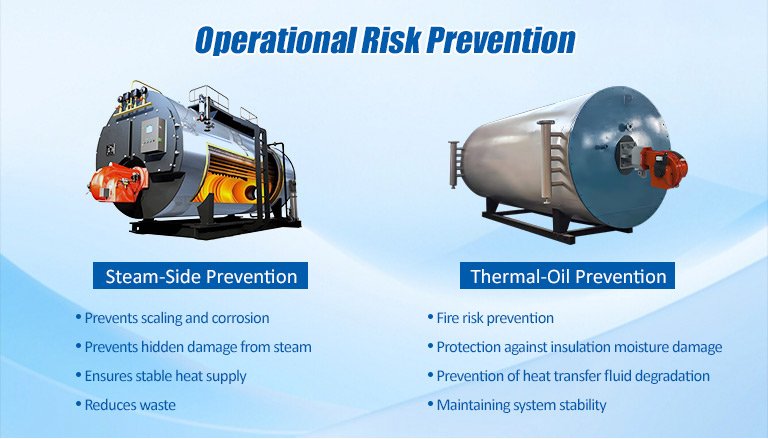
Daily risk control depends on the inspection routine, the speed of loss or leak detection, and documented acceptance boundaries. For steam, risk often comes from undetected water-side damage and distribution losses. For thermal oil, risk grows from leakage and poor fluid condition. A plant should verify that staffing and inspection access match the chosen system’s needs.
Steam system prevention depends on a consistent water-side routine and distribution inspection.
· Prevent scale and corrosion by verifying water treatment and test records.
· Prevent hidden steam loss by verifying the trap inspection routine.
· Prevent unstable heat delivery by checking condensate drainage.
· Prevent waste by verifying blowdown rates match water conditions.
Thermal oil system prevention depends on loop integrity and monitoring.
· Prevent fire by verifying leak detection and isolation plans.
· Prevent insulation wetting by checking insulation selection.
· Prevent fluid degradation by verifying operating limits and air controls.
· Prevent instability by verifying flow and temperature monitoring.
A prevention plan should be confirmed during commissioning to ensure monitoring points and response actions work as intended.
Choosing between a steam boiler and a thermal oil boiler for industrial heating depends on three key factors: heat-user temperature, pressure limits, and acceptance workload. A choice based on these variables is more defensible than one based on generic pros and cons. We clarify these decision anchors to keep the project scope stable.
EPCB Boiler designs and makes industrial steam boilers, and we align project inputs with verification steps. We clarify boundary items like temperature targets and acceptance documents because project success depends on these constraints. The final choice should be verified against site layout, inspection access, and operating capacity.
For the next step, share your process temperature targets, pressure limits, heat-load profile, and acceptance method. We can then compare options on the same basis and align a system scope your site can verify during commissioning.
Send You Inquiry
Give You Boiler Solution
Place The Order
Get Your Boiler