

For industrial enterprises, choosing a boiler is not simply a matter of determining the steam volume, operating pressure, and equipment model. What truly affects a company's long-term production costs and operational stability often includes a more fundamental issue: whether fuel can be supplied reliably, and whether the company can consistently obtain the energy it needs at a reasonable cost.
Especially in regions where natural gas supply fluctuates seasonally, an industrial boiler that relies entirely on natural gas for operation, even with good thermal efficiency, may face the risk of reduced load or even shutdown due to insufficient fuel supply.
EPCB Boiler has discovered through its long-term service to industrial clients worldwide that for many companies, reducing boiler operating costs does not necessarily mean replacing the entire production system. Sometimes, by starting with fuel selection, combustion methods, boiler operating modes, and system matching, and through reasonable technical adjustments, a company's overall energy costs can be significantly improved.
It was against this backdrop that EPCB, together with an industrial customer from Uzbekistan, launched a challenging boiler project— to develop a dual-fuel boiler system that could flexibly use either natural gas or coal, depending on local energy availability.
This is not just a boiler equipment supply, but also a customized engineering design tailored to the customer's actual energy conditions.
Natural Gas Supply Instability Drives Demand for Flexible Boiler Solutions in Uzbekistan
Uzbekistan has abundant natural gas resources, which is also an important energy source for many local industrial enterprises.
For industrial boiler users, gas-fired boilers are characterized by high automation, convenient operation, flexible combustion adjustment, and a relatively clean on-site environment. Therefore, natural gas is often the preferred boiler fuel for enterprises.
However, there is a practical problem in the customer's area:
Natural gas supply is not stable enough throughout the year.
Especially during the winter when energy demand increases, some regions may experience reduced natural gas pressure or insufficient supply.
For ordinary residential gas users, such fluctuations may only cause some inconvenience; but for industrial production enterprises that rely on a continuous supply of steam, the problem is much more serious.
If the boiler cannot obtain enough natural gas, the boiler evaporation rate may decrease.
If the steam pressure remains insufficient, the production equipment will be unable to operate at its normal load.
In severe cases, it could even lead to the shutdown of the entire production line.
Production stoppages due to energy issues could cause even greater indirect losses. Therefore, when selecting a new boiler, customers didn't simply ask "I need a gas-fired boiler," but rather raised a more practical question:
Is there a type of boiler that can take advantage of the convenience of natural gas while also ensuring factory production when natural gas supply is insufficient?
This question ultimately became the starting point for the entire project design.
Why EPCB Recommends Dual-Fuel Boilers for Greater Fuel Flexibility
At the beginning of the project, EPCB did not directly recommend a standard boiler, but instead conducted a systematic analysis of the local energy conditions based on the customer's actual production situation.
In addition to boiler capacity and steam pressure, the engineering team focused on assessing the stability of natural gas supply, changes in gas supply during winter, coal procurement conditions, price differences between the two fuels, and the plant's requirements for continuous steam supply.
Analysis revealed that the key to this project was not maximizing efficiency with a single fuel, but rather improving the operational resilience and fuel adaptability of the steam system in the face of changes in energy supply and prices.
Natural gas has the advantages of easy regulation and high degree of automation; coal has relatively stable local supply channels and has a cost advantage in some periods.
Therefore, EPCB proposed the use of dual-fuel industrial boilers (gas-fired/coal-fired).
Custom Gas and Coal Dual-Fuel Boilers Require Comprehensive System Design
On the surface, a dual-fuel boiler seems to simply require a single boiler to burn two types of fuel.
However, from an engineering design perspective, things are far more complicated than that.
The combustion mechanisms of natural gas and coal are significantly different.
After natural gas enters the burner, it can be mixed with air in a certain proportion and burned quickly in the furnace.
Coal is a solid fuel that needs to go through different stages, including feeding, heating, ignition, combustion, and burnout.
If a gas burner is simply installed on a traditional coal-fired boiler without reconsidering the furnace structure and combustion organization, the boiler may not be able to maintain good operating performance under both fuel conditions.
Therefore, for the EPCB engineering team, this project was not a routine standard product selection, but a truly customized boiler development project .
Dual-Fuel Furnace Design Supports Both Natural Gas and Solid Fuels
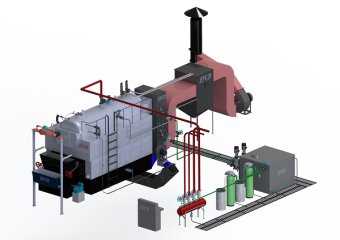
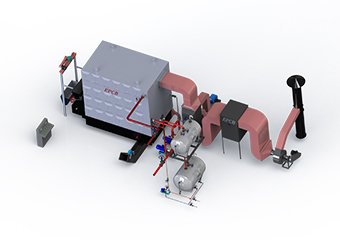
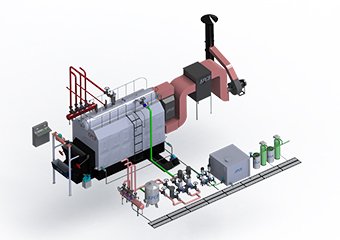
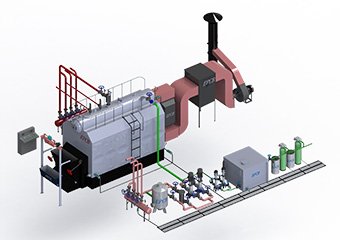
After multiple rounds of technical analysis and structural design, EPCB finally developed a dual-fuel boiler solution that meets the customer's needs, combining gas and coal combustion.
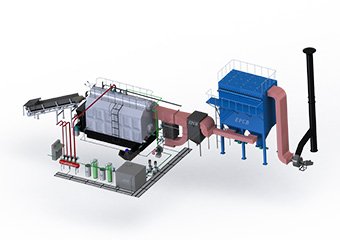
The boiler body is equipped with a grate system at the bottom, which can meet the combustion needs of solid fuels such as coal.
When using solid fuels, after coal enters the grate, it undergoes ignition, combustion, and burnout in sequence under reasonable furnace space and air distribution conditions, and the heat generated by combustion is transferred to the boiler water through the boiler heating surface.
At the same time, EPCB has set up a dedicated gas burner interface in the furnace combustion area.
When customers use natural gas as fuel, the burner enters the combustion zone through the corresponding position at the front of the boiler and adjusts the amount of natural gas and combustion air according to the boiler load.
In this way, a boiler becomes capable of adapting to different energy supply conditions.
When natural gas supply is sufficient, natural gas can be used as a priority.
When natural gas supply is insufficient, coal can be switched to depending on the actual operating conditions.
For customers, the real value lies not in the feature that "the boiler can burn two types of fuel," but rather in:
Production no longer depends entirely on one type of fuel.
This significantly improves the flexibility of the plant's energy supply.
Flexible Fuel Selection Helps Reduce Industrial Boiler Operating Costs
EPCB’s research on various industrial boiler projects has found that fuel costs are often one of the most significant components of a boiler’s total life-cycle cost.
Therefore, evaluating the economic efficiency of a boiler system should not only consider the equipment purchase price, but also take into account:
How much energy will be required to produce one ton of steam in the next few years or even the next decade or so?
Single-fuel boilers are easily affected by fluctuations in the price and supply of a particular energy source, while dual-fuel systems offer businesses more flexible options.
Customers can:
• Natural gas prices
• Coal procurement costs
• Seasonal variations
• Energy supply situation
• Production load and steam demand
Adjust the boiler operation mode flexibly.
When natural gas prices are favorable and supply is stable, gas-fired operation can be prioritized; when coal is more cost-effective, or when natural gas experiences seasonal supply shortages, solid fuel operation can be switched to.
In regions with significant fuel price differences, optimizing fuel selection and operating methods can effectively reduce overall fuel costs and improve the stability of steam supply.
This is also a concept that EPCB has always emphasized:
True energy conservation is not just about improving boiler thermal efficiency, but also about helping customers choose operating methods that are more suitable for local energy conditions.
Months of Collaboration Turn a Custom Boiler Concept into an Engineered Solution
A truly customized boiler that suits a client can rarely be determined in a single meeting.
Throughout the project, EPCB maintained continuous communication with the client for several months. From natural gas supply and coal prices to boiler structure, combustion methods, and site conditions, both parties continuously adjusted and improved the technical solutions.
The EPCB engineering team focuses not only on equipment quotes, but also on in-depth discussions with clients: Why is dual-fuel required? Which fuel will be the primary or backup? Is local supply stable? Are there future capacity expansion plans? How can the system be made easier to operate and maintain?
These issues ultimately led to a solution that better meets the actual production needs of our customers.
For EPCB, this is precisely the difference between customized boiler projects and the sale of standard products:
Quoting a price is only part of the project; the real beginning is understanding the client's production needs and operational logic.
EPCB Delivers Complete Boiler System Solutions from Manufacturing to Commissioning
After the final design was finalized, the project entered the manufacturing phase.
To ensure that the dual-fuel structure can be realized as designed, EPCB has implemented strict controls on key manufacturing processes.
For boiler projects with a high degree of non-standardization, the equipment itself is only a part of the entire system.
Other factors that truly affect the final outcome of a project include:
Is the combustion system compatible?
Is the ventilation and smoke system reasonable?
Is the fuel supply smooth?
Can the control system achieve safety interlocking?
Is the boiler room site suitable for equipment layout?
Do the operators understand the operating requirements for different fuel modes?
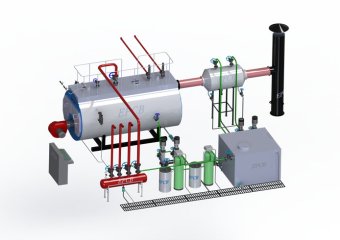
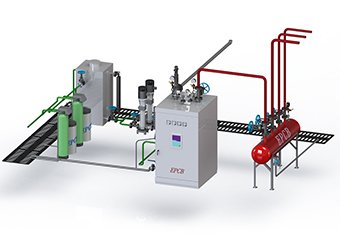
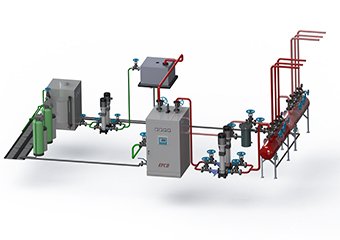
Therefore, EPCB places greater emphasis on the overall matching from the boiler body to the complete system .
This is also the "boiler system solution" concept that EPCB has been continuously strengthening in recent years:
Instead of manufacturing a single pressure vessel, we design the entire system around the steam output that the customer ultimately needs.
EPCB Builds Customer Value Through Industrial Boiler Problem-Solving Expertise
After the project was completed, the client gave positive feedback on the new dual-fuel boiler.
For customers, EPCB doesn't really solve the problem of "lacking a boiler".
The client's initial concern was:
What to do if there is a shortage of natural gas?
How can production be guaranteed during winter?
What to do about changes in energy prices?
If we continue to rely on a single fuel, will we face the same problem again in the future?
EPCB's final solution was not to make customers accept these risks, but to provide them with a new energy option by redesigning the boiler combustion system.
From requirements analysis to solution design, from engineering research and development to equipment manufacturing, and then to system matching for actual operating environments, this approach of working around customer problems further demonstrates EPCB's value as an industrial boiler system supplier.
More Than Boilers: EPCB Delivers Reliable Industrial Energy Solutions
For decades, industrial boilers have served the fundamental task of providing heat and steam to factories. However, with fluctuating energy prices, increasing environmental requirements, and businesses placing greater emphasis on production continuity, customers' expectations of boiler suppliers are also changing.
Customers no longer need just a steam-generating device, but a professional partner who can help businesses stabilize production, reduce energy costs, improve fuel adaptability, control operational risks, and provide long-term technical support.
This is also the direction for EPCB's continued development.
From initial needs assessment, fuel analysis, and boiler selection, to system design, manufacturing, installation guidance, commissioning training, and after-sales service, EPCB aims to provide comprehensive project services to ensure that every boiler truly adapts to the customer's production environment.
The Uzbekistan gas/coal dual-fuel boiler project is one such example. Faced with the problem of unstable natural gas supply, EPCB did not simply recommend a standard boiler, but instead designed a dual-fuel solution that allows for flexible selection between natural gas and coal, based on the customer's actual energy conditions.
This reflects the principles that EPCB has always adhered to:
The problems raised by customers should not only be recorded, but should also become the starting point for engineers to find better solutions.
This is also EPCB's understanding of professional services.
We not only manufacture boilers, but also help customers solve the production problems behind the boilers.
EPCB Boiler — Your Private Boiler System Expert.