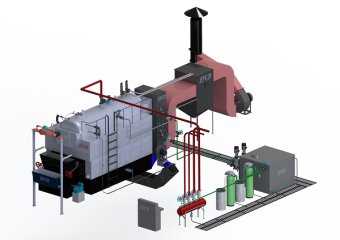
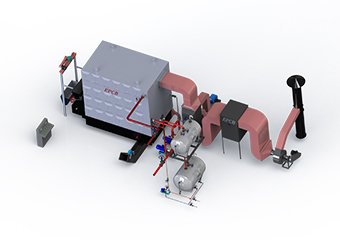
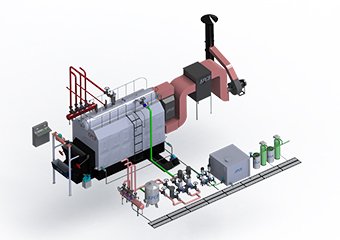
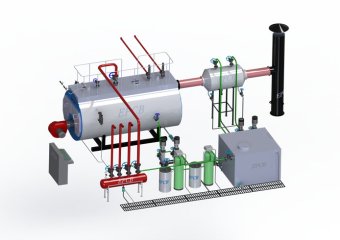
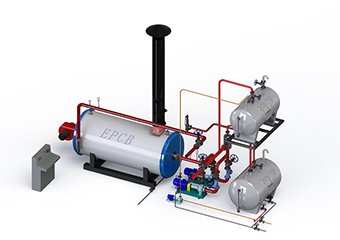
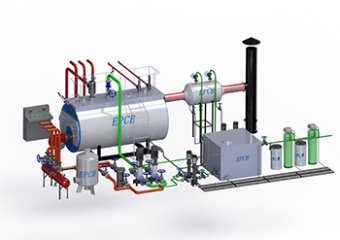
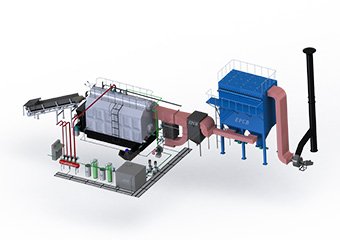
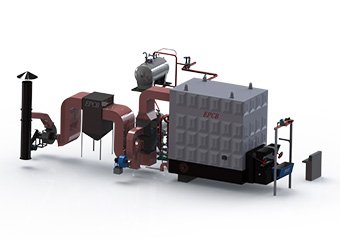
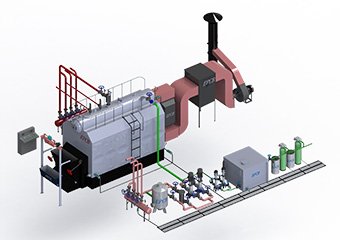
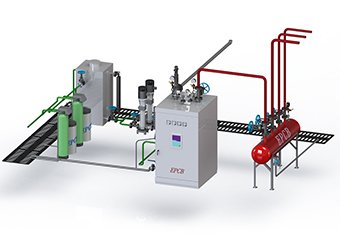
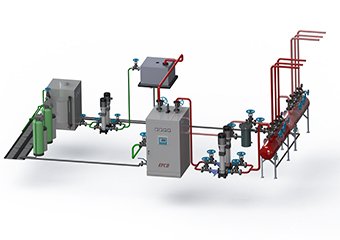


In January 2026, a Bangladeshi chemical company officially reached a procurement agreement with EPCB for a 15-ton coal-fired steam boiler system. The project will adopt a complete coal-fired steam supply solution, including the boiler body, economizer, air preheater, coal feeder, slag remover, multi-tube dust collector, wet dust collector, and related supporting equipment.
This is not the first time the chemical company has collaborated with EPCB.
Prior to this project, the client had already purchased and used two EPCB industrial steam boilers, one a 10-ton coal-fired boiler and the other a 15-ton gas-fired boiler. Through long-term operation, the client has fully recognized the manufacturing quality, operational stability, and after-sales service of the EPCB boilers.
As the company's production system continues to operate and its steam supply demand continues to increase, the customer plans to purchase a new 15-ton coal-fired steam boiler to replace the currently operating 10-ton coal-fired steam boiler. Although other boiler suppliers offered lower prices for this project, the company ultimately chose to continue its cooperation with EPCB.
Customers' decisions are not simply based on equipment price, but rather on years of practical experience. For industrial enterprises, the true value of a boiler lies not only in its purchase cost, but also in its long-term operational safety, stability, fuel efficiency, maintenance costs, and after-sales service capabilities.
This renewed collaboration fully demonstrates the client's long-term trust in the quality and professional services of EPCB industrial boilers.
Long-Term Boiler Performance--Choose EPCB for a Third Time
Industrial boilers are essential power equipment for manufacturing enterprises. Unlike general-purpose equipment, boilers need to operate continuously for extended periods and directly impact the steam supply to the production line.
For chemical companies, a stable steam supply is usually closely related to process heating, equipment insulation, raw material handling, and other production processes. If the boiler experiences unstable steam pressure, insufficient steam supply, abnormal combustion, or equipment failure, it may affect the continuity of the entire production system.
Therefore, when selecting a new boiler supplier, customers often need to consider multiple aspects, including:
Whether the boiler can stably reach its rated output;
Whether the steam pressure can meet the production requirements;
Whether the fuel can burn completely;
Is the boiler body structure reliable?
Is the auxiliary equipment configuration complete?
Are the environmental protection facilities compatible with the boiler?
Is it easy to operate and maintain?
Can the manufacturer continue to provide technical support?
Can after-sales service be obtained in a timely manner after a problem occurs?
The company had previously used EPCB's 10-ton coal-fired steam boiler and 15-ton gas-fired steam boiler, and had direct knowledge of the actual operating performance of EPCB's boiler systems for different fuels.
Unlike getting to know a supplier solely through quotations, product samples, or business introductions, repeat purchases by existing customers are based on judgments made on long-term, actual operational experience.
The customer has already validated the equipment quality, system stability, and service responsiveness of EPCB boilers through existing projects. Therefore, when the company is preparing to replace its existing 10-ton coal-fired boiler with a new 15-ton coal-fired steam boiler, EPCB naturally becomes a key partner for the customer.
Why Upgrade from a 10 T/h to a 15 T/h Coal-Fired Steam Boiler?
The core objective of this project is to purchase a new 15-ton coal-fired steam boiler to replace the currently used 10-ton coal-fired steam boiler.
Upgrading from 10 tons to 15 tons means that the customer wants to further increase the steam supply capacity of the coal-fired boiler system and leave more room for steam supply in the production system.
In industrial production, boiler selection should not only consider the current average steam consumption, but also comprehensively analyze peak production load, simultaneous operation of equipment, steam pipeline losses, future expansion plans, and reserve capacity.
If the boiler operates at near full load for an extended period, it may increase the operating pressure on the combustion system and auxiliary equipment, and it will also make it difficult for the company to flexibly adjust the steam supply according to production changes.
By adopting a larger-capacity 15-ton coal-fired steam boiler, customers can reasonably adjust the boiler load according to actual steam demand, providing greater adjustment space for subsequent production arrangements while meeting existing production needs.
At the same time, the new boiler is not simply an expansion of the boiler capacity, but a comprehensive configuration of the fuel delivery, combustion, heat exchange, slag removal and flue gas treatment systems.
Based on project requirements, EPCB provides customers with complete coal-fired steam boiler systems consisting of the boiler body, heat recovery equipment, fuel conveying equipment, slag removal equipment, and multi-stage environmental protection facilities.
This systematic configuration helps to better coordinate the operation of various devices and avoids the problem of focusing only on the boiler body and neglecting the matching of auxiliary equipment.
15 T/h Coal-Fired Steam Boiler: The Core of Reliable and Stable Steam Supply
The boiler body is the core equipment of the entire steam system. Its structural design, heating surface arrangement, material selection and manufacturing quality directly affect the boiler's evaporation capacity, operational stability and service life.
In response to the operational characteristics of a 15-ton coal-fired steam boiler, EPCB focused on furnace space, fuel combustion process, flue gas flow, heat exchange of heating surfaces, and boiler load regulation capability in its design.
During operation, coal-fired boilers require a stable fuel supply and a reasonable air ratio. Only when the fuel, air, grate operation, and flue gas flow are matched can a stable combustion state be achieved.
A well-designed furnace helps provide sufficient space for coal combustion, allowing the fuel to have an appropriate combustion time within the furnace, thereby reducing incomplete combustion.
As flue gas passes through the boiler's heating surfaces, it transfers heat to the boiler water, continuously generating the steam required for production. By optimizing the flue gas flow path and the arrangement of the heating surfaces, heat utilization can be improved and unnecessary flue gas heat loss can be reduced.
For chemical enterprises that need to operate for a long time, boilers must not only meet the requirements during short-term trial operation, but also maintain relatively stable steam pressure and output during daily production.
EPCB prioritizes boiler quality control throughout the equipment manufacturing and project execution process. From raw materials, welding, non-destructive testing to hydrostatic testing and final inspection, each step must adhere to relevant standards to ensure the long-term operation of the equipment.
Economizer for Coal-Fired Steam Boilers: Flue Gas Heat Recovery and Improved Energy Efficiency
This 15-ton coal-fired steam boiler system is equipped with an economizer to recover waste heat from the boiler tail flue gas and preheat feedwater, thereby reducing the fuel required for heating feedwater, reducing flue gas heat loss, and improving the system's energy utilization rate.
Economizers need to be rationally designed based on boiler load, feedwater parameters, flue gas temperature, and subsequent dust removal equipment to reduce problems such as low-temperature corrosion, ash accumulation, and increased flue gas resistance. EPCBs are integrated with boiler capacity and flue gas flow to ensure coordinated operation of the economizer, boiler body, air preheater, and flue gas treatment equipment.
Air Preheater for Coal-Fired Boilers: Waste Heat Recovery for Improved Combustion Efficiency
In addition to the economizer, this project is also equipped with an air preheater to recover the waste heat of the flue gas at the tail end of the boiler and preheat the combustion air, thereby improving the ignition and combustion conditions of coal.
The air preheater needs to be properly matched with the blast system, grate system, and combustion regulation method to ensure that the furnace receives an appropriate and stable amount of combustion air, reducing heat loss caused by incomplete combustion or excessive air. Through the coordinated operation of the boiler body, economizer, and air preheater, the waste heat of flue gas can be utilized in stages, improving the overall energy efficiency of the entire steam system.
Automated Coal Feeding System: Improving Fuel Supply Efficiency and Reducing Manual Handling
A 15-ton coal-fired steam boiler requires a continuous and stable fuel supply. To reduce manual handling and improve conveying efficiency, this project is equipped with a coal feeder to continuously deliver coal to the boiler's coal feeding system.
A stable coal feed rate helps maintain stable furnace temperature and steam pressure. By coordinating the coal feeder with the combustion system, operators can adjust the fuel supply according to boiler load and steam demand, ensuring continuous and stable boiler operation.
Mechanical Slag Removal System: Ensuring Continuous Grate Operation and Stable Combustion
Coal combustion in the furnace produces slag, which, if not removed promptly, can accumulate and affect grate operation and continuous boiler combustion. Therefore, this project is equipped with a mechanical slag remover to continuously transport the slag to a designated area.
Mechanized slag removal reduces manual cleaning, lowers the risk of high-temperature operations, and ensures a smooth slag removal process. EPCB's solution design integrates the coal feeding and slag removal systems, creating a complete cycle of fuel delivery, combustion, and slag discharge to guarantee the long-term stable operation of the 15-ton coal-fired boiler.
Multi-Tube and Wet Dust Collectors: Building an Efficient Multi-Stage Flue Gas Treatment System
Environmental protection features for coal-fired boilers are an important part of this project. The 15-ton coal-fired steam boiler from the chemical factory is equipped with a multi-tube dust collector and a wet scrubber, forming a multi-stage flue gas treatment system.
Multi-tube dust collectors utilize centrifugal separation to prioritize the removal of larger dust particles from flue gas, reducing the processing load on subsequent environmental protection equipment. The flue gas then enters a wet scrubber, where it comes into full contact with water or absorbent liquid to further capture fine dust and some pollutants.
EPCB is matched as a whole based on fuel characteristics, flue gas volume, dust concentration, system resistance and local environmental protection requirements, so that the boiler body, waste heat recovery equipment, dust removal facilities and fan system operate in a coordinated manner, thereby improving the flue gas treatment effect and system operation stability.
Why Customers Choose EPCB Over Lower-Priced Boiler Suppliers
During the transaction process, other boiler suppliers in the market offered the customer lower prices.
Price is an important evaluation factor for any industrial equipment procurement project. However, boilers are special equipment that need to operate for a long time, and the initial purchase price is only a part of the total project cost.
Customers also need to consider long-term factors such as subsequent fuel consumption, downtime due to malfunctions, spare parts supply, maintenance costs, operational difficulty, equipment lifespan, and technical support.
If the equipment is purchased at a low price but frequently malfunctions during operation, or if the supplier cannot provide timely technical support, then the company may have to bear higher downtime and maintenance costs.
The company has already used two EPCB boilers and has direct experience with the equipment quality and after-sales service. The customer knows what kind of products EPCB can provide and understands what kind of support they can receive during project installation, operation, and maintenance.
Therefore, even though competitors offered lower prices, the customer still chose EPCB.
This selection demonstrates that for mature industrial enterprises, procurement decisions are not simply about finding the lowest price, but about choosing partners with lower overall risk and higher long-term value.
The client's willingness to continue working with EPCB is an affirmation of the past project results and a sign of trust in the EPCB brand, technical capabilities, and service system.
EPCB: A Long-Term Partner for Reliable Industrial Steam System Solutions
The ultimate goal of industrial enterprises in purchasing boilers is not to own a piece of equipment, but to obtain a safe, stable, economical and continuous supply of steam.
Therefore, EPCB designs solutions for every project from the perspective of a complete steam system.
From the boiler body to the economizer and air preheater, from the coal feeder and slag remover to the multi-tube dust collector and wet dust collector, each piece of equipment performs a different function. Only when each component is properly matched can the entire system operate stably.
The signing of this 15-ton coal-fired steam boiler procurement agreement with the chemical factory of Bangladesh is a continuation of the long-term cooperation between the two parties and a further recognition of EPCB boiler quality and service capabilities by the customer.
In the future, EPCB will continue to adhere to the principle of basing its work on the actual needs of its customers, providing professional steam boiler and thermal energy system solutions for the chemical, food, textile, pharmaceutical, paper, rubber, palm oil processing and other industrial sectors.
EPCB not only focuses on whether the equipment can be delivered smoothly, but also on whether the boiler can operate stably at the customer's site for a long time, whether it can help customers reduce operational risks, and whether it can provide reliable energy support for the production system.
From the first collaboration to continuous repeat purchases, from equipment supplier to long-term steam system partner, customer trust has always been the driving force for EPCB to continuously improve its products and services.