Benefits of Biomass for Industrial Boilers: What We See in Real Projects at EPCB

January 13, 2026

Introduction

Biomass gives the best value in industrial boilers when a site has reliable local fuel, steady heat demand, and a good plan for storage and handling. In those cases, the benefits appear in three areas: emissions strategy, waste management, and long-term energy cost stability.


At EPCB, we design and customize industrial biomass boiler systems for plants that want reliable steam or hot water without depending on fossil fuel price changes. This guide covers the benefits—what they are, why they occur, and the conditions that make them work in daily operations.


Biomass Fuel Basics for Industrial Boilers

Biomass Fuel Basics for Industrial Boilers


Biomass for industrial boilers is combustible organic material that you can supply consistently. It must have the right moisture, size, and cleanliness for your combustion system. In practice, the best biomass is not always the cheapest per ton. It is the one you can source steadily, store safely, feed reliably, and burn cleanly with stable output.


Most industrial applications we support use solid biomass fuels like wood residues, pellets, or agricultural residues. These fuels burn to create heat that makes steam or hot water for processes. The key is not just the chemistry. It is the fuel's real behavior—moisture, ash, particle size, and variability. That decides performance consistency.


Wood residues and pellets — consistent boiler fuel for year-round heat


Wood-based biomass is often the most predictable choice when you need stable, year-round thermal output. It comes in forms like chips, sawdust, shavings, bark, or densified pellets. This depends on the local supply chain.


When wood fuels are prepared well and delivered to a stable spec, they are easier to meter. They stay consistent across seasons. This is why many industrial sites choose wood residues or pellets when available locally. The benefit is operational stability. A consistent fuel leads to consistent steam conditions and fewer combustion issues.


Agricultural residues — converting field waste into usable thermal energy


Agricultural residues offer strong value when they are abundant, nearby, and handled with a realistic plan for seasonality. Common examples include straw, husks, shells, and other crop by-products. These would otherwise need disposal.


The advantage is not just fuel cost. It is waste avoidance and local resource use. However, these fuels often have higher variability in moisture and ash. They can be more seasonal. The benefit works when the supply chain handles that variability. This includes storage practices and fuel preparation that keep feeding stable.


Industrial by-products — turning onsite organics into a local fuel stream

Onsite organic by-products create the most direct waste-to-energy benefit when the plant controls the fuel stream. Examples include biomass residues from processing operations. The material comes continuously or predictably.


The benefit here is less about finding the cheapest fuel. It is more about cutting disposal burdens while creating useful heat. When the by-product stream is steady, the boiler operates with stable load response. When the stream is inconsistent, the system design must handle it without disrupting process steam supply.


Environmental Benefits in Industrial Heating

Environmental Benefits in Industrial Heating


Biomass can cut net greenhouse gas impact compared to fossil fuels. This happens when the fuel comes from responsible sources and the supply chain runs well. In industrial heating, that value often comes from replacing fossil combustion. It also comes from avoiding landfill methane from organic waste. Plus, it uses locally available materials that would otherwise burn openly or get discarded.


Keep the benefit statement precise. People often call biomass carbon neutral. But real results depend on feedstock type, sourcing practices, transport distance, and the fossil baseline replaced. In EPCB projects, we see the environmental benefit as conditional. It is strongest when the biomass stream is an unavoidable residue or well-managed resource. It also needs efficient system operation.


Biomass can help with compliance planning. Many industrial facilities need ways to lower carbon intensity over time. Biomass combustion still creates stack emissions. But modern boiler systems can control particulate and other pollutants. They do this through good combustion design and emissions controls. In other words, the environmental benefit is not just about CO₂. It is also about handling emissions responsibly in real operations.


Waste Reduction and Resource Efficiency

Waste Reduction and Resource Efficiency


Biomass creates a clear waste-management benefit. It turns organic residues into useful heat instead of sending them to landfills or disposal routes. For many industries, waste is not just an environmental issue. It is a ongoing operational cost. This ties to hauling, tipping fees, compliance, and storage limits.


When a site uses biomass from residues, it can cut landfill volume. It lowers risks from unmanaged organic waste. Organic waste in landfills can release methane as it decomposes. Diverting that material to energy use can cut those impacts. It improves overall resource efficiency.


From a plant manager's view, the benefit gets practical when the fuel stream acts as a controlled input. It is not a pile of mixed waste. This means setting acceptable materials, keeping contamination low, and organizing storage. The fuel must stay usable. At EPCB, we design biomass boiler systems around the fact that waste streams vary. The best results come when the site sets a fuel specification. It builds handling practices to protect that spec.


Decision checklist: when waste-to-energy benefits are strongest


· You have a steady volume of clean organic residue or access to a nearby consistent supplier.


· Current disposal creates cost, compliance burden, or operational risk.


· Your facility can allocate space for safe storage and controlled fuel handling.


· You have predictable heat demand so the recovered energy is continuously useful.


Operational Stability and Energy Security


Biomass can boost energy security for industrial heating. This works when the site sources fuel locally and stores it for continuous operation. Unlike solar or wind, solid biomass fuel is storable. That helps industrial boilers. Many plants need stable steam or hot water no matter the weather or grid issues.


In practice, the stability advantage appears as operational resilience. If your fuel supply is diversified—especially with local residues—your heating system faces less global commodity volatility. For facilities in areas with fuel price swings or supply limits, biomass adds predictability. It cuts disruption risk.


Operational reliability ties to controllability. Industrial biomass boilers can meet steady output needs. They support a wide range of uses, including process steam, hot water, and thermal oil systems. The key is matching the system to your load profile and fuel behavior. A stable heat load and well-managed fuel supply make reliability benefits easier to achieve.


At EPCB, we stress that reliability is a system result. It is not a marketing claim. It comes from fuel handling, combustion stability, controls, maintenance access, and operator training. When those pieces fit, biomass serves as a dependable industrial heat source.


Economic Value and Cost Predictability


Biomass systems can provide economic value. This happens when fuel supply is reliable and local. Evaluate the project over the full operating life, not just upfront cost. For many industrial users, the strongest financial benefit is not cheap fuel. It is less exposure to fossil price volatility. You can stabilize heating costs with a supply chain you control.


Upfront investment for biomass boilers can be higher than simple fossil systems. You are not just buying a boiler. You are building a fuel ecosystem: storage, handling, feeding, and ash management. However, operating costs can compete when biomass pricing is stable. Or when the plant turns waste products into fuel. That is where predictability becomes a business advantage.


In many cases, clients want a simple payback statement. Payback varies widely because fuel economics are site-specific. In our experience, a multi-year ROI window is realistic for many industrial conversions. It depends on baseline fuel costs, local biomass availability, and utilization level. A plant with steady thermal demand and short transport distances for fuel usually sees stronger economics. This beats a plant with fluctuating load and long-distance supply.


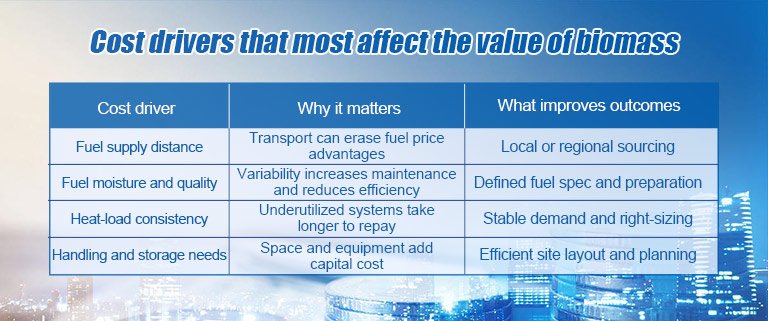
Cost drivers that most affect the value of biomass


Cost driver

Why it matters

What improves outcomes

Fuel supply distance

Transport can erase fuel price advantages

Local or regional sourcing

Fuel moisture and quality

Variability increases maintenance and reduces efficiency

Defined fuel spec and preparation

Heat-load consistency

Underutilized systems take longer to repay

Stable demand and right-sizing

Handling and storage needs

Space and equipment add capital cost

Efficient site layout and planning


We also consider the direction of regulation and carbon constraints. We do this without making the article a policy discussion. If emissions rules tighten over time, low-carbon heating strategies often gain extra financial value. Treat that as a risk management benefit. It is not a guaranteed revenue line.


Cost drivers that most affect the value of biomass

What Determines How Much Benefit You Get


The benefits of biomass are not the same everywhere. They depend on your site's fuel reality, heat demand, and operational constraints. Two plants can install similar biomass boilers and get different results. One may have consistent fuel and steady load. The other may have high variability and limited space.


The first driver is fuel sourcing and consistency. A reliable supplier network or controlled onsite residue stream makes benefits easier to capture. If fuel quality fluctuates, the boiler can still run. But efficiency and stability depend more on handling and combustion control.


The second driver is storage and handling practicality. Biomass is bulky compared to many fossil fuels. Safe storage matters. If space is tight or the site cannot protect from moisture, the system can face issues. The benefits stay real. But you achieve them through better planning, not hopes.


The third driver is emissions management readiness. Biomass combustion creates pollutants that need responsible control. If a project includes proper emissions control strategies and monitoring plans, the environmental benefits are easier to defend. You can maintain them over time.


The fourth driver is load profile and integration. Biomass works best when the plant has steady thermal demand and a clear use for recovered heat. If demand varies a lot, the system design must reflect that. This keeps efficiency and reliability stable.


At EPCB, our customization approach focuses on aligning these drivers with the client's reality. The goal is not to sell biomass. It is to help a facility capture the benefits it expects. This avoids surprises from mismatched fuel, load, or space constraints.


FAQ


1) Is biomass really carbon neutral for industrial boilers?

Biomass can reduce net carbon impact compared to fossil fuels. But carbon neutral depends on how the fuel is sourced and the supply chain behind it. If the biomass is a responsibly managed residue stream with reasonable transport distance, the climate benefit is usually stronger. If sourcing leads to poor land-use outcomes or long transport routes, the benefit can shrink.


2) What are the main benefits of biomass in industrial boiler applications?

The most common benefits are better emissions strategy, improved waste utilization, and more predictable long-term heating costs under the right conditions. Biomass also supports energy security when fuel can be sourced locally and stored for continuous operation. The size of each benefit depends on fuel consistency, site layout, and heat-demand stability.


3) Does biomass reduce landfill waste in a meaningful way?

Yes, when the fuel is made from organic residues that would otherwise be landfilled or disposed of inefficiently. Diverting those materials can reduce landfill volume and help avoid methane emissions from decomposition. The benefit is strongest when the waste stream is clean and managed as a consistent fuel input.


4) Is biomass reliable compared with other renewable energy options?

Biomass can be reliable for industrial heat because the fuel is storable and the boiler can operate on demand. Unlike intermittent sources, it does not depend on sunlight or wind at the moment you need steam. Reliability still depends on fuel supply planning and proper handling systems.


5) How do I know if my facility is a good fit for biomass benefits?

You are usually a strong fit if you have local access to consistent biomass, enough space for storage and handling, and steady thermal demand. If any of those factors are weak, the project can still work. But benefits may require more careful system design and operational planning. A site-specific feasibility review is the fastest way to confirm fit.


6) Can biomass help reduce operating costs even if the upfront cost is higher?

It can, when the fuel supply is stable and the system is well utilized across the year. Many projects see value through cost predictability and reduced exposure to fossil price swings, not only through absolute fuel savings. Outcomes depend on local fuel economics, transport distance, and how consistently your plant uses heat.


Conclusion

Biomass offers real benefits for industrial boilers when the project builds around stable fuel, steady heat demand, and practical handling and emissions planning. In those conditions, it can support lower-carbon heating strategies, improve waste utilization, and cut long-term exposure to fossil fuel volatility.


At EPCB, we customize industrial biomass boiler systems to match the fuel you can secure and the heat your process needs. If you share your fuel options, expected moisture and ash range, available space, and your steam or hot-water demand profile, we can help evaluate whether biomass benefits will be strong in your specific operating reality.


  • Send You Inquiry

  • Give You Boiler Solution

  • Place The Order

  • Get Your Boiler

Ask for Boiler Solution Suited Your Condition!

Tell us your need about boiler capacity in your industry, we will recommend the most suitable boiler model for you!

Consult online customer service
Product:
Boiler fuel: