Gas fired boiler is a high-efficiency energy conversion equipment that uses natural gas, liquefied gas, city gas and other gases as the main fuel. Exploring the operating mechanism of gas fired boilers is the key to further understanding the basic principles and performance of this heating equipment. EPCB Boiler will conduct an in-depth analysis to understand how the gas boiler operates to reveal its efficient energy conversion process and the operating principle of providing reliable heating to users.
This article covers the working principle, components, boiler types, flue gas path, and startup sequence of gas fired boilers. It applies to fire-tube and water-tube designs in commercial and industrial applications.
Working Principle of Gas Fired Boiler
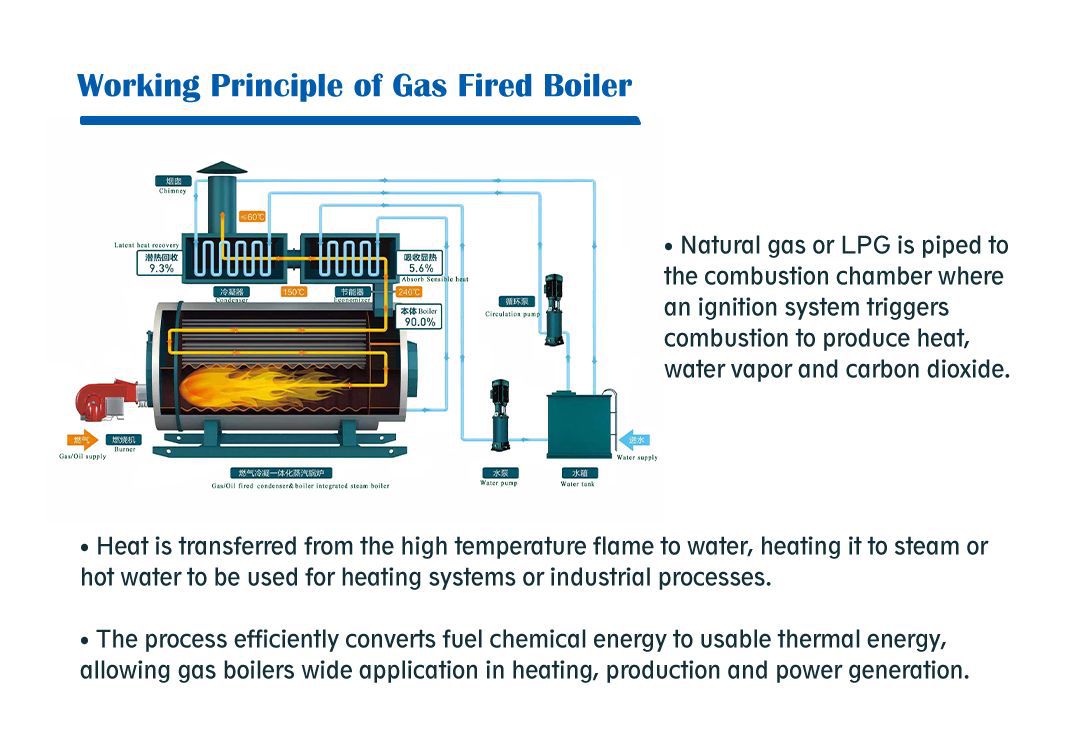
The basic working principle of a gas fired boiler is based on burning gas in the furnace to release high-temperature heat energy. By heating the water in the boiler, the water is heated and evaporated, and finally stable and controllable steam is produced. This thermal energy conversion process mainly involves two key aspects: combustion process and thermal energy conversion.
First, fuel, usually natural gas or LPG, is piped into the combustion chamber. In the combustion chamber, the ignition system triggers the ignition process, causing the combustion of gas. This combustion process is a chemical reaction in which fuel partially burns with oxygen in the air, producing heat, water vapor and carbon dioxide.
The entire combustion process is carried out quickly and accurately in the gas fired boiler to ensure efficient energy conversion, maximize the use of fuel energy, and provide a stable heat source for the heating system. The control and optimization of this process is a key consideration in the design of modern gas boilers, aiming to increase thermal efficiency, reduce emissions, and ensure equipment reliability.
Next, enter the heat energy conversion stage, which is the process of burning fuel to generate high-temperature flames, and then transferring this heat energy to the water in the boiler, and finally heating the water into steam or providing hot water. This is the core function of the gas fired boiler. Through this A process in which water is heated and converted into hot water or steam, depending on the design and purpose of the boiler.
The hot water or steam generated is then transported to areas that require heating, such as heating systems or industrial processes, to meet the corresponding energy needs. The entire process achieves efficient conversion from the chemical energy of fuel to practical thermal energy, making gas fired boilers widely used in fields such as heating, production and power generation.
Main Components of Gas Boiler System
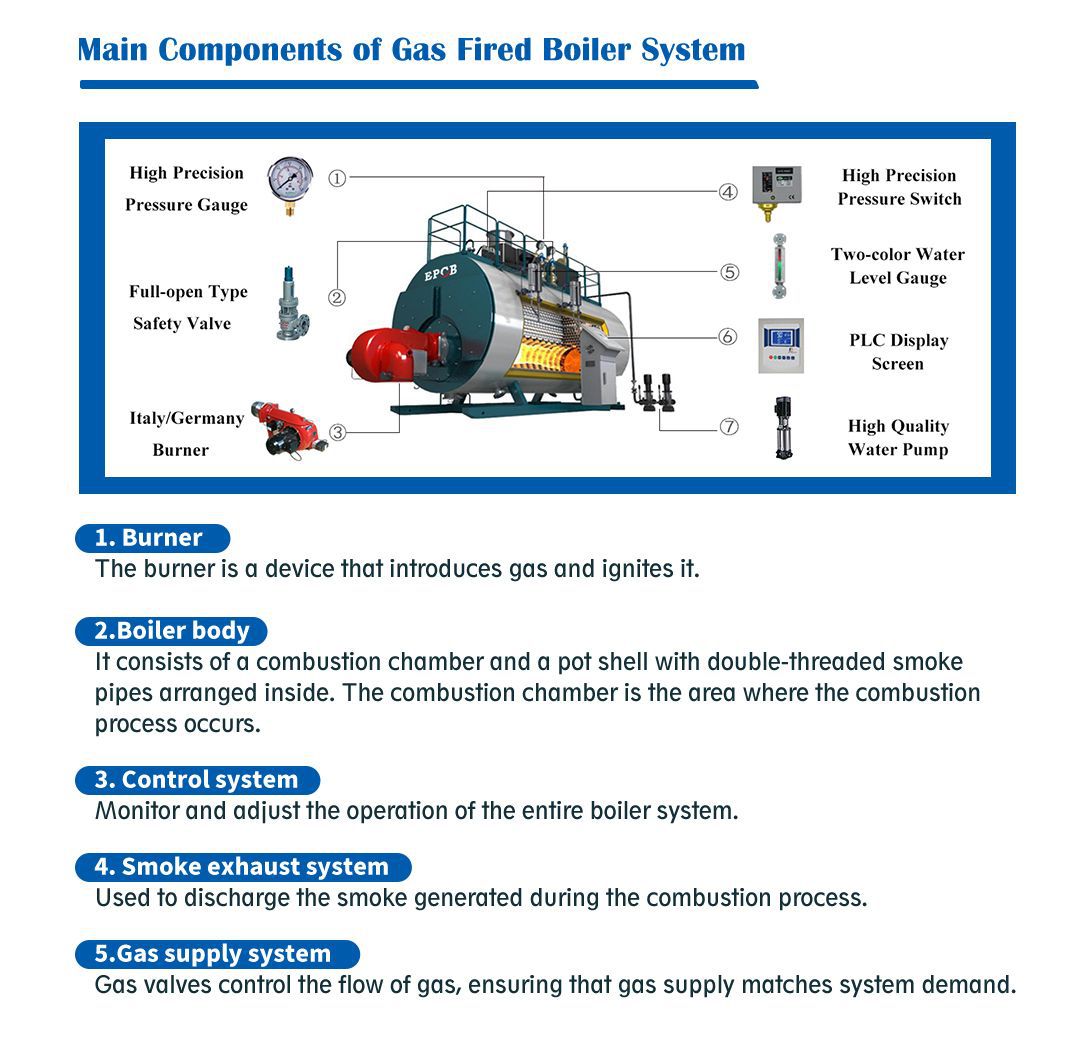
The fired boiler is mainly composed of burner, boiler body, control system, water circulation system, gas supply system and smoke exhaust system.
As a complex energy conversion system, a gas boiler includes multiple key components, each of which plays a unique role and together ensures the efficient operation of the entire system.
Burner: Mixes natural gas with air and ignites the mixture. Modern industrial boiler gas burner systems modulate firing rate across a turndown range—typically 4:1 to 10:1, with burner type and sizing significantly affecting overall system performance.
Combustion chamber: The space where the gas flame burns. In fire-tube boilers, this is a corrugated steam boiler furnace running through the center of the boiler shell, whose geometry directly influences flame stability and heat flux distribution.
Heat exchanger: Flue gases pass through tube bundles, transferring heat to the surrounding water. The number of passes determines how much heat is recovered before exhaust reaches the stack—a process central to steam boiler energy transformation and overall system efficiency.
Control system:Monitors steam pressure or water temperature, adjusts burner firing rate, and manages safety interlocks. Key sensors include pressure transmitters, temperature sensors, water level probes, and flame detectors. Safety logic—governed by ASME CSD-1—shuts down the burner if water drops below the low-water cutoff (LWCO), if steam pressure exceeds the high-limit setpoint, or if flame fails to establish during ignition.
Water and steam circulation system:In a steam boiler, feedwater heats to saturation temperature at operating pressure. Steam separates from the water and exits through the steam outlet. In a hot water boiler, a circulation pump moves water continuously through the boiler and distribution circuit.
Flue gas exhaust system:Combustion products exit through the rear smoke chamber into the flue connector and chimney. Where an economizer is installed, flue gases pass through it first—recovering heat to preheat incoming feedwater.
Types of Gas Fired Boilers
Type | Output | Key Condition | Typical Application |
Gas steam boiler | Saturated or superheated steam | Operating pressure drives output | Food, textiles, pharma, chemical |
Gas hot water boiler | Hot water at controlled temperature | Circulation pump maintains flow | District heating, hotels, commercial |
Condensing gas boiler | Steam or hot water | Return water below ~55°C required | Low-temp district heating, preheat |
Non-condensing gas boiler | Steam or hot water | Standard return temperatures | Most industrial process applications |
Gas steam boilers:produce steam for process use. Most industrial applications use saturated steam. Superheated steam is specified when the process requires higher energy content or drier steam at the point of use.
Gas hot water boilers:heat water for circulation. They are the standard specification for space heating in commercial buildings, hotels, and district heating networks.
Condensing gas boilers:recover latent heat from water vapor in flue gases. This happens by cooling exhaust below the water vapor dew point—approximately 50–60°C for natural gas, depending on gas composition. Thermal efficiency reaches 96–98% on an LHV basis under condensing conditions, though not all units on the market achieve this range—making it important to understand what defines the most efficient steam boiler before making a selection. Condensing operation only occurs when return water stays consistently below approximately 55°C. Above that threshold, the boiler runs in non-condensing mode regardless of its design. We confirm return water temperature profiles across seasonal load variations before specifying a condensing unit.
Fire-tube vs. water-tube design is a structural decision that applies across all types, affecting operating pressure, footprint, cost, and maintenance requirements.
| Factor | Fire-Tube | Water-Tube |
| Flue gas path | Inside tubes; water surrounds them | Outside tubes; water inside |
| Typical capacity | Up to ~20 t/h | 10 t/h and above |
| Typical pressure | Up to ~1.6 MPa | Up to 10+ MPa |
| Capital cost | Lower | Higher |
| Best fit | Most commercial and industrial use | High-pressure process, large-scale industrial |
These ranges reflect common configurations—not absolute design limits. Some fire-tube designs exceed these thresholds. Confirm design type against load data, design pressure, and OEM product range.
Gas Boiler Overall workflow:
The burner introduces gas and mixes it with air.
The burner ignites the gas mixture through the ignition system.
The combustion process takes place in the combustion chamber, producing hot gases at high temperatures.
The heat exchanger transfers heat energy to the water, causing the water temperature to rise.
The hot water or steam generated is piped to the area that needs to be heated.
Gas Boiler Startup Process
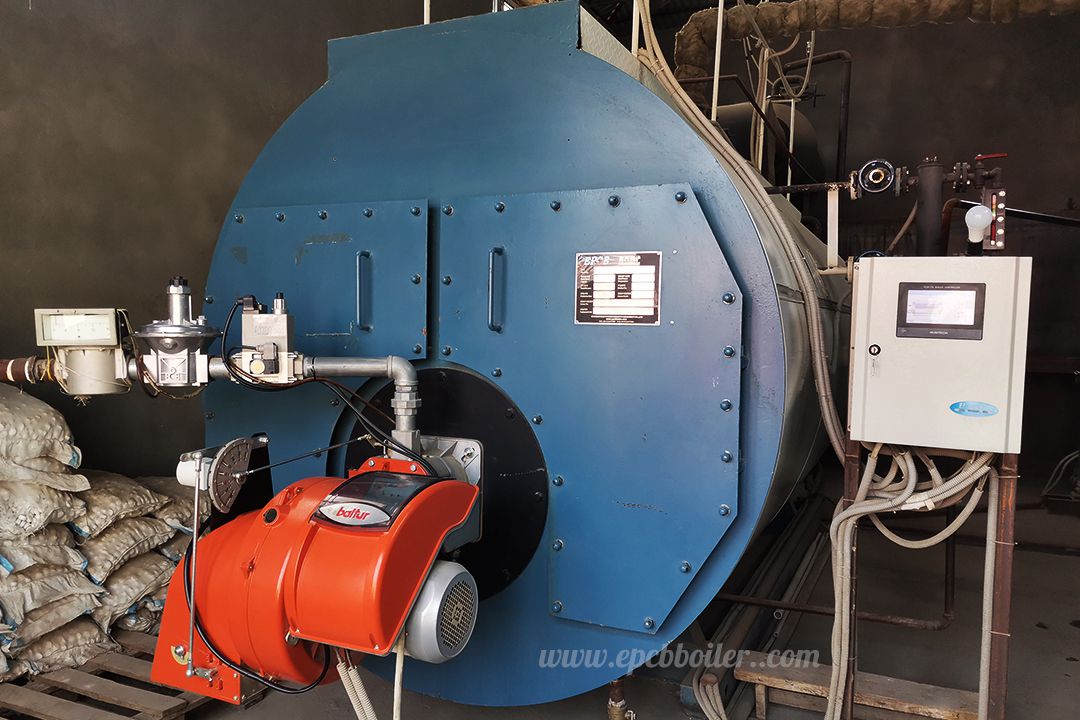
Startup follows a defined sequence controlled by the burner management system (BMS). NFPA 85 sets the safety logic framework for purge interlocks, trial-for-ignition timing, and mandatory shutdowns. Specific timing values depend on combustion chamber volume, burner type, and OEM requirements. They are not universal and should not be transferred between installations without engineering review.
Pre-start checks: Confirm water level is within the normal range, gas supply pressure is within the burner's specified range, isolation valves are correctly positioned, and the flue path is clear.
Purge cycle: The BMS runs an automatic pre-purge—airflow through the combustion chamber to clear residual unburned gas before ignition. Duration is set by the BMS per OEM requirements.
Ignition: The ignition system energizes while the gas valve opens to low-fire position. The BMS monitors for flame confirmation within the defined trial-for-ignition period. If flame is not confirmed, the BMS locks out. Manual reset requires investigation of root cause before restarting.
Ramp to operating pressure: After ignition, the burner modulates upward to setpoint. The control system maintains target pressure or temperature by modulating between minimum and maximum turndown positions.
Heat Energy Transfer Process
The thermal energy transfer process of a gas boiler is the process of converting the thermal energy of the fuel into the thermal energy of water, and finally providing steam or hot water. This process involves key steps such as combustion, heat energy transfer and water circulation.
Combustion process: Gas boilers first mix fuel (usually natural gas, liquefied gas, etc.) with air through a burner. In the combustion chamber, the mixed gas is ignited to form a high-temperature flame. This combustion process causes the chemical energy within the fuel to be released as heat energy.
Radiation and convection heat energy transfer: The high-temperature flame transfers heat energy to the boiler body through radiation and convection. Radiation is transmitted through the smoke tube and directly acts on the surface of the gall body to heat it up. Convection is the movement of gas around the flame, which transfers heat energy to the water in the tank.
Heating and circulation of water:The boiler tank is filled with water. Thermal energy transfer causes the water temperature to rise, thereby increasing the water's thermal energy. The heated water begins to undergo convection, that is, hot water rises and cold water falls, forming a natural circulation of water. In a steam boiler, the heating of water eventually causes the water to vaporize, forming steam.
Utilization of steam or hot water:The generated steam or heated hot water can be used in different applications such as heating, industrial production or hot water supply. In a steam boiler, the steam is usually piped to where it is needed, while in a hot water boiler, the hot water can be used directly for heating or other purposes.
Frequently Asked Questions and Maintenance of Gas Boilers
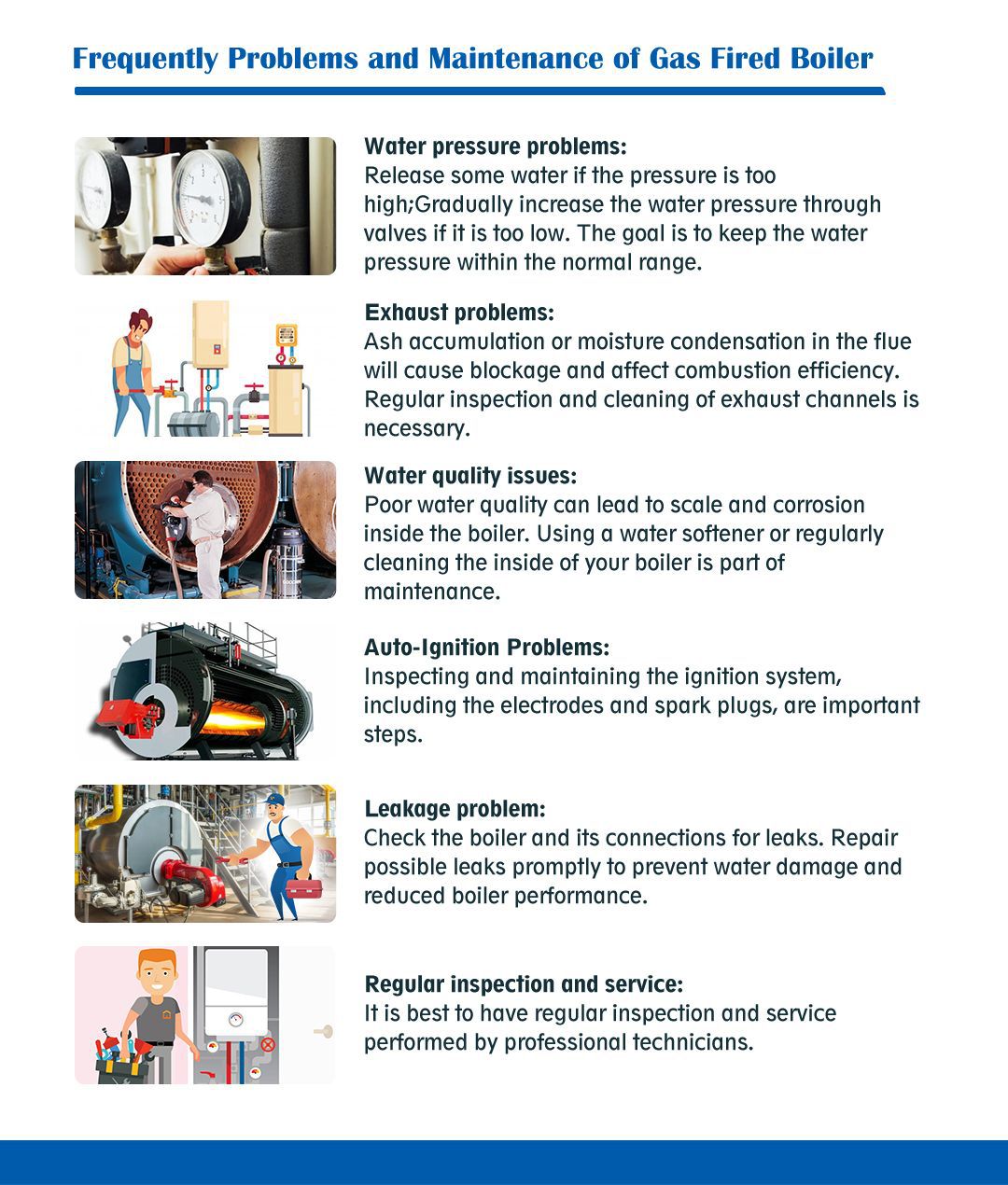
Anticipating common problems and maintaining your gas boiler is crucial to ensuring the efficient operation of your equipment. The following are some common problems that may occur and corresponding maintenance methods:
Water Pressure Issues:
Water pressure that is too high or too low in your gas boiler can cause problems. If the water pressure is too high, drain some water to reduce the water pressure. If the water pressure is too low, gradually increase the water pressure through the boiler water inlet valve or the exhaust valve in the system to ensure that the water pressure is within the normal range. Regularly checking and adjusting water pressure are important maintenance steps.
Exhaust problem:
The boiler exhaust system may be blocked. The cause of the blockage may be dust accumulation in the flue or moisture condensation, which affects the combustion efficiency. The flue should be cleaned regularly to ensure that dust and carbon deposits do not affect the exhaust. Regular inspection and cleaning of exhaust channels is necessary.
Water quality issues:
Poor water quality can lead to scale and corrosion inside the boiler. Regularly use water softening equipment to treat the water entering the boiler to reduce the mineral content in the water. Using a water softener or regularly cleaning the inside of your boiler is part of maintenance.
Auto-ignition issues:
If the auto-ignition system fails, the boiler will not start properly. Inspecting and maintaining the ignition system, including the electrodes and spark plugs, are important steps.
Leakage problem:
Check the boiler and its connections for leaks. Repair possible leaks promptly to prevent water damage and reduced boiler performance.
Regular cleaning:
Dust and debris will accumulate inside the boiler, affecting heat exchange efficiency. Regular cleaning of the inside of your boiler, including the heat exchanger and combustion chamber, is key to ensuring efficient operation.
Regular inspection and service:
It is best to have regular inspection and service performed by professional technicians. They can identify potential problems and perform necessary maintenance and repairs.
Through regular steam boiler maintenance and timely repair, you can ensure long-term efficient and safe operation of your gas boiler, reducing energy waste and unnecessary repair costs.
Conclusion
A gas fired boiler burns natural gas in a combustion chamber, passes flue gases through a multi-pass heat exchanger, and discharges cooled exhaust through the flue system. Boiler type—steam or hot water, condensing or non-condensing, fire-tube or water-tube—determines which applications it suits. All parameter ranges in this article are indicative. Final values must be verified against OEM documentation, applicable codes (ASME BPVC Sections I, IV, or VI; ASME CSD-1; NFPA 54 and 85), and the authority having jurisdiction.
In our experience with gas fired boiler installations across food processing, textiles, pharmaceuticals, and heating applications, two variables separate a well-performing system from a poorly set-up one: whether the air-fuel ratio was optimized at commissioning with a combustion analyzer, and whether annual service included a documented combustion analysis. Both are part of every commissioning and service scope we deliver.
If you are specifying a gas fired boiler, share your steam output requirement, operating pressure, load profile, fuel supply conditions, and applicable code jurisdiction with our team. We will confirm the right type and capacity, specify the correct burner and control configuration, and align the commissioning scope to your operating requirements.
FAQ
What is the difference between a fire-tube and water-tube gas fired boiler?
In a fire-tube boiler, hot gases flow inside the tubes and water surrounds them. In a water-tube boiler, water flows inside the tubes and gases flow around the outside. Fire-tube designs typically suit applications up to approximately 20 t/h and 1.6 MPa. Water-tube designs handle higher pressures and larger outputs. Confirm the right type against the manufacturer's product range and the specific load and pressure requirements of the application.
What does the air-fuel ratio affect?
It controls combustion completeness and efficiency. Too little air produces CO and carbon deposits. Too much dilutes the flame and increases heat loss through the flue. The optimal setting depends on the burner model, load range, NOx limits, and OEM strategy. We verify and document this at commissioning and recheck it at every annual service.
Why does exhaust gas temperature matter?
It shows how much heat transferred to the water before flue gas left the stack. A rise above the expected range typically means scale on heat transfer surfaces, excessive excess air, or a fouled heat exchanger—each requiring investigation.
What causes a gas boiler to fail to ignite?
Four root causes: insufficient gas pressure, misaligned or fouled electrodes, a failed ignition transformer, or a blocked gas valve. Diagnose in that sequence. Replacing parts before confirming root cause adds cost without fixing the problem.
How often does a gas fired boiler need servicing?
Annual service by a qualified technician is the standard baseline, consistent with ASME CSD-1 requirements. Annual service should include: burner wear parts replacement, combustion analysis with a calibrated analyzer, heat transfer surface inspection and cleaning, safety device testing including LWCO and pressure relief valve, and flue path inspection. Daily and weekly checks—water level, pressure, and control function—remain the operator's responsibility.
What water treatment does a gas fired boiler require?
It depends on feedwater source, operating pressure, makeup water volume, and boiler materials. ABMA guidelines define parameters by pressure range. The specific program should be set by a qualified water treatment supplier against the actual installation. A generic pH range is not a sufficient specification.





 Steam Boiler
 Thermal Oil Boiler
 Hot Water Boiler
 Steam Boiler
 Thermal Oil Boiler
 Hot Water Boiler
 Steam Boiler
 Thermal Oil Boiler
 Hot Water Boiler
 Steam Boiler
 Hot Water Boiler